
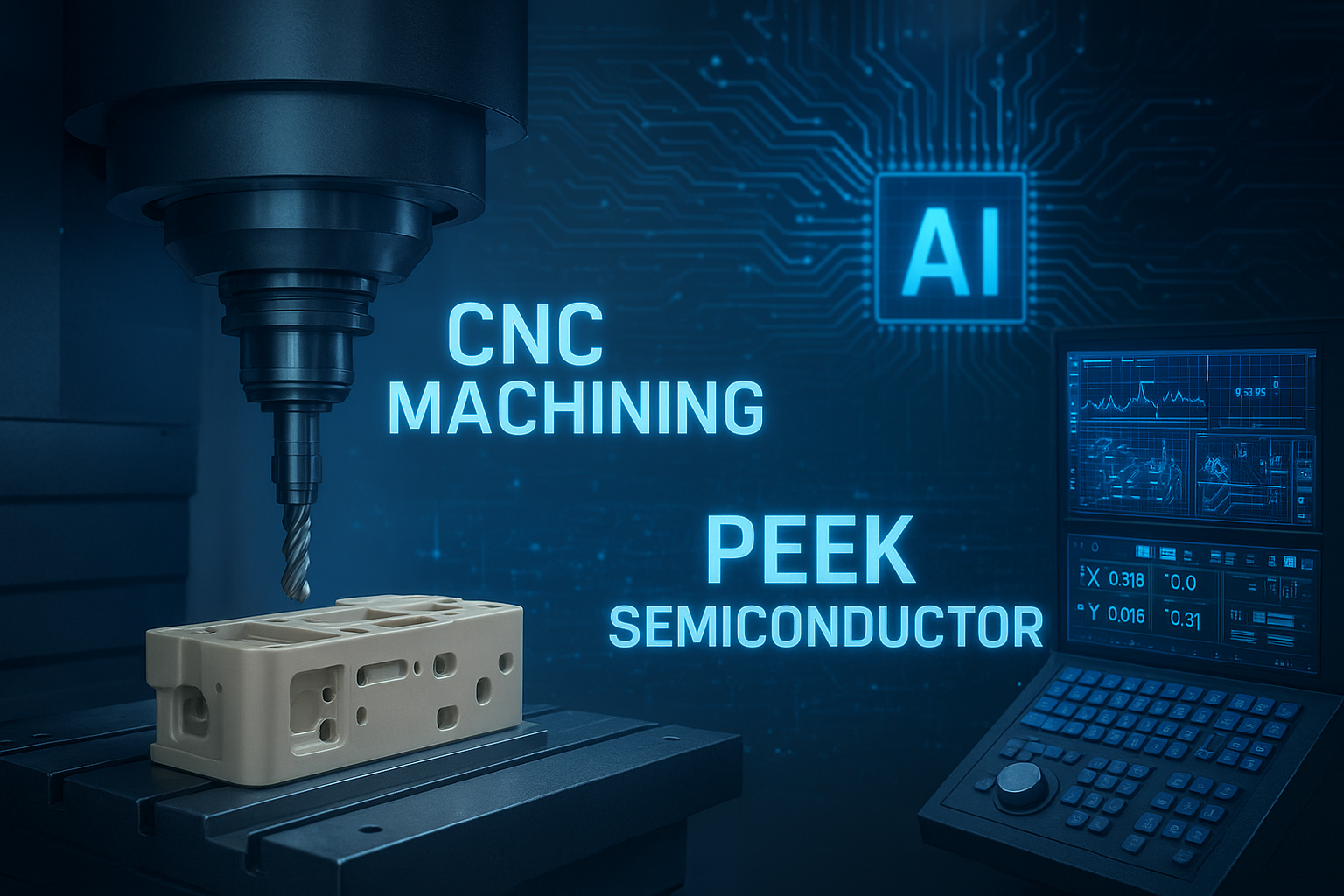
How PEEK Works in Medical Applications and How It Integrates with CNC Machining
✅ The Role of PEEK in Medical and Healthcare Applications
PEEK (Polyether Ether Ketone) is a high-performance engineering polymer with:
- High strength and low weight
- High temperature resistance (steam-sterilizable)
- Excellent biocompatibility (implant-grade)
- Chemical and fatigue resistance
- Radiolucency under X-ray and CT (no metal artifacts)
Common medical applications include:
- Spinal fusion cages
- Dental implant abutments
- Surgical tools and disposable guides
- Joint replacement components
- Orthopedic fixation plates
🌟 Manufacturing Workflow of PEEK Medical Devices
Medical components require high precision, surface quality, and durability.
PEEK machining differs from metals and demands advanced control.
🏭 CNC + PEEK Integration Process
1️⃣ Raw Material Preparation
- PEEK rods or sheets
- Medical-grade or implant-grade PEEK (e.g., Invibio)
2️⃣ CNC Machine Setup (Core Process)
Machining PEEK focuses on high speed, low cutting force, and thermal control.
Key considerations:
- Tools: Sharp carbide end mills and drills
- Spindle speed: 10,000–24,000 rpm
- Feed rate: High feed to prevent melting
- Cooling: Air cooling or MQL (avoid emulsions due to moisture absorption)
- Workholding: Soft jaws to prevent deformation
3️⃣ CNC Machining of Medical Components
Example – PEEK spinal cage manufacturing:
- Rough milling
- Contour shaping
- Slotting and hole machining
- Surface texturing for osseointegration
- Fine finishing
4️⃣ Inspection & Quality Control
- CMM dimensional measurement
- Surface roughness testing (Ra 1.6–0.8 μm)
- Radiolucency verification
- Strength & fatigue tests
5️⃣ Cleaning & Sterilization
PEEK supports:
- Autoclave
- Gamma radiation
- EtO sterilization
6️⃣ Assembly, Packaging & Certification
Depends on application:
- ISO 13485
- USP Class VI
- FDA 510(k) / CE approval
🔧 Why CNC Machining Is Ideal for PEEK in Medical Devices
- High precision (±0.01 mm)
- No metal-like internal stress during machining
- Ability to create complex 3D structures
- Suitable for small-batch customized medical components
📌 Summary
PEEK’s biocompatibility and mechanical strength make it a leading implant material, while CNC machining provides the precision and flexibility required for advanced medical manufacturing.
Smart Machinery × CNC Manufacturing × PEEK × Semiconductor
Driving the Future of Manufacturing Efficiency & Sustainable Growth
As global manufacturing advances toward intelligent automation and sustainability, smart machinery, digital transformation, green energy and low-carbon production are redefining the value of modern machine tools. At the same time, CNC precision machining and high-performance materials such as PEEK have become indispensable in semiconductor and automation industries.
1. Smart Machinery Boosts Manufacturing Efficiency
Machine tools equipped with AI, sensors and automated controls deliver higher real-time stability and precision.
- Reduces labor dependence and human error
- Real-time feedback improves yield and stability
- Integrates with robotic arms & unmanned lines
- Predictive maintenance and remote scheduling
2. CNC Precision Strengthens Semiconductor Manufacturing
Semiconductor equipment demands micro-scale accuracy, and CNC is the core foundation of such components.
| Component Type | Required Performance |
|---|---|
| Vacuum chambers | High sealing & corrosion resistance |
| Fixtures & alignment modules | High rigidity and concentric accuracy |
| Ceramic & engineering plastics | Low deformation rate |
| Motor/linear module bases | High stability & low vibration |
Smart CNC machining optimizes toolpaths, lowers energy usage, and maintains nano-class precision.
3. High-Performance PEEK Enhances Semiconductor Reliability
PEEK features high heat resistance, chemical stability, low wear and minimal moisture absorption — ideal for semiconductor use.
Typical PEEK CNC Components:
- Transfer module sliders & guide bushings
- Etching/CVD insulation parts
- Ultra-low-friction carriers
- High-vacuum structural components
Combined with 5-axis CNC machining, PEEK provides lighter weight, tighter tolerances and improved energy efficiency — in line with future net-zero goals.
4. Sustainability & Low-Carbon Technology — The New Standard
Energy-efficient servo drives, regenerative braking systems and low-friction machining allow:
🌱 20–40% energy reduction
🌱 Lower tool consumption and waste output
🌱 Improved carbon-cost management & competitiveness
Future machine tools must be smart + precise + sustainable, aligning with semiconductor-grade production and new-material technology.
Conclusion
Smart machinery × CNC machining × Semiconductor technology × PEEK
= The driving force of future industrial efficiency and sustainability.
#PEEK, #CNC Machining, #CNC Precision Machining, #Semiconductor Components, #Automation Equipment, #Precision Components, #Robotic Arms, #Stainless Steel Machining, #Engineering Plastics, #Ceramic Machining
Yong Yi Technology Co., Ltd. logo
location: No. 188-9, Section 1, Dafeng Road, Tanzih-ku, Taichung City, Taiwan 42756, China
call: +886-4-25341382
ring volume: +886-4-25341847
email: yongyi-sales@umail.hinet.net
email: justinwu6767@gmail.com