
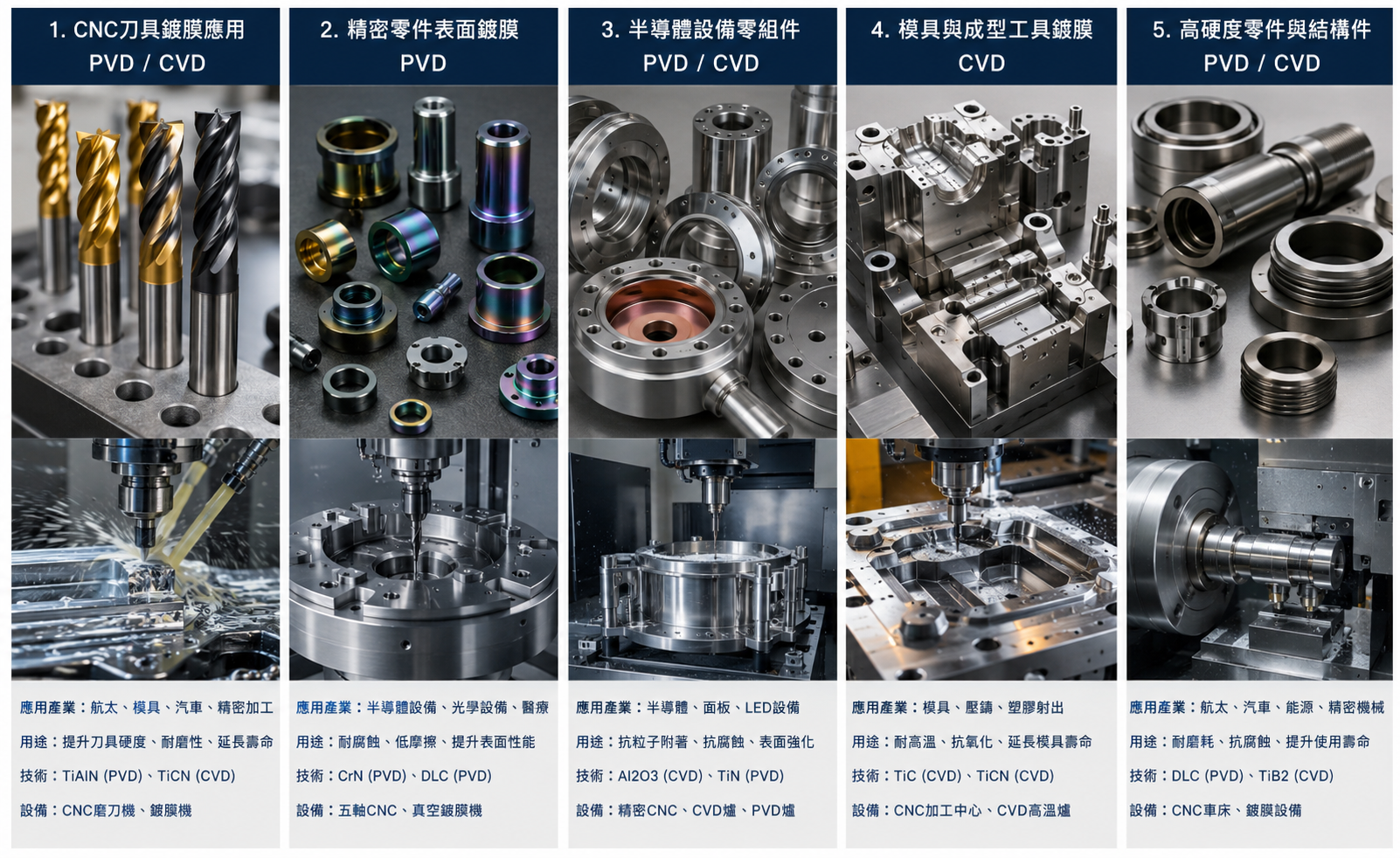
PVDとCVDは、薄膜成膜における2つの主要な技術です。CNC加工、精密部品製造、半導体製造装置部品、工具コーティング、高度な表面処理におけるそれぞれの役割、用途、製造プロセス、および違いについて解説します。
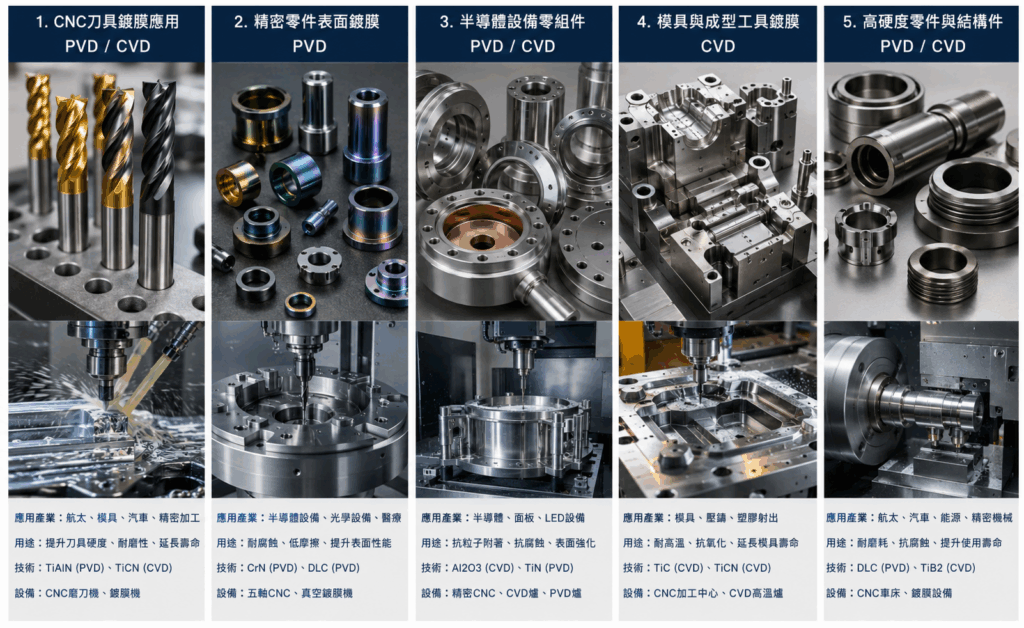
PVD(物理蒸着)とCVD(化学蒸着)は、薄膜成膜における2つの主要な技術です。PVDは、蒸発やスパッタリングなどの物理的プロセスを利用して材料を蒸着・堆積させるため、金属コーティングや高硬度・耐摩耗性コーティングに適しており、低温で動作します。一方、CVDは、分解や合成などの化学反応を利用して基板上に薄膜を形成するため、優れた被覆性と複雑な構造への適用性を備えています。半導体絶縁層や高品質の硬質コーティングに一般的に用いられ、通常は高温で動作します。
PVD(物理蒸着)原理:高真空環境下で、物理的方法(加熱蒸発やイオン スパッタリングなど)を使用して材料源(ターゲット)を原子化し、それをワークピース表面に堆積します。利点:環境に優しい(有毒ガスなし)、低い成膜温度(基板への影響が最小限)、良好なコーティング密着性、高硬度、安定した膜。欠点:コーティング特性が劣る(3D構造表面の均一性が低い)、蒸発源の反対側の位置への堆積が困難。用途:機械工具の耐摩耗性コーティング(TiN、TiAlN)、装飾コーティング(時計、宝飾品)、半導体金属配線。CVD(化学蒸着)原理:堆積材料を含む気体前駆体を反応チャンバーに導入し、そこで基板表面で化学反応または分解を起こして固体薄膜を堆積します。
利点:優れたコーティング特性(全方向の被覆が可能)、堆積層の高い純度と密度、複雑な薄膜を製造可能。欠点: 反応温度が高い (通常 400 °C 以上)、有害なガスを伴うことが多い。 用途: 半導体エピタキシー、誘電体層 (SiO₂)、導電性金属層、人工ダイヤモンド製造。
PVD と CVD の主な違いの概要 特性 PVD (物理蒸着) CVD (化学蒸着) 成膜メカニズム 物理蒸着/スパッタリング 化学反応/分解 反応温度 低い (約 200 °C ~ 500 °C) 高い (通常 >500 °C) 被覆性が低い (視野が狭く、複雑な 3D 構造には不向き) 被覆性が高い (適合性が高く、複雑な形状に適している) 非常に高い 膜硬度 (硬質コーティングに適している) 高い (材料による) 主な用途 工具表面処理、金属膜、半導体、絶縁層、ダイヤモンド膜 まとめ: 選択方法?
PVDを選択する場合:低温処理、高硬度、比較的単純な形状が求められる表面(例:フライス加工用カッター、ドリルビット、装飾品)。
CVDを選択する場合:微細で高い適合性、高密度が求められる薄膜(例:ICトランジスタ構造、複雑な機械部品)。
1. What is PVD? (Physical Vapor Deposition)
Physical Vapor Deposition
1️⃣ The Role of PVD in CNC Machining
In CNC precision machining, PVD is one of the most widely used technologies for cutting tool coating and precision component surface enhancement. It deposits nanometer-scale thin films onto workpiece surfaces by evaporating or sputtering metallic materials in a vacuum environment.
For applications such as:
- CNC Turning
- CNC Milling
- 5-Axis CNC Machining
- Micro Precision Machining
- High-Speed CNC Cutting
PVD significantly improves:
Key Benefits in CNC Machining:
✅ Increased cutting tool hardness
✅ Reduced cutting friction coefficient
✅ Extended CNC tool life
✅ Enhanced high-speed machining stability
✅ Improved surface roughness quality
✅ Reduced tool chipping rate
✅ Better production consistency in mass manufacturing
PVD has become a standard process especially in:
- CNC Stainless Steel Machining
- CNC Titanium Machining
- CNC Aerospace Components
- CNC Semiconductor Equipment Parts
- CNC Micro Precision Components
2. Applications of PVD in CNC Machining
1️⃣ CNC Cutting Tool Coating
Common PVD coatings include:
- Titanium Nitride (TiN)
- Titanium Aluminum Nitride (TiAlN)
- Chromium Nitride (CrN)
- Diamond-Like Carbon (DLC)
Applied to:
- CNC End Mills
- CNC Drill Bits
- CNC Taps
- CNC Turning Tools
- Micro Machining Tools
These coatings ensure long-term stable cutting performance for CNC machining, 5-axis machining, and automated manufacturing lines.
2️⃣ Precision CNC Component Coating
Applications include:
- Semiconductor Vacuum Chamber Components
- Precision Fixtures
- Linear Guide Components
- Bearing Housings
- Optical Equipment Parts
Benefits:
✅ Wear Resistance
✅ Scratch Resistance
✅ Corrosion Resistance
✅ Low Friction
✅ Dimensional Stability
This is especially critical for:
- High-Precision CNC Parts
- OEM Precision Components
- Semiconductor Equipment Manufacturing
3. PVD Factory Process (CNC Manufacturing Workflow)
Step 1: CNC Precision Machining
- CNC Milling
- CNC Turning
- 5-Axis Machining
- Precision Grinding
Ensuring tight dimensional tolerances.
Step 2: Surface Pre-Treatment
- Ultrasonic Cleaning
- Degreasing
- Acid Cleaning
- Plasma Cleaning
Ensuring contamination-free CNC surfaces.
Step 3: Vacuum Coating
Inside vacuum chambers:
- Evaporation
- Arc Ion Plating
- Magnetron Sputtering
Depositing thin films onto CNC machined parts.
Step 4: Quality Inspection
- Coating Thickness Measurement
- Adhesion Testing
- Surface Roughness Inspection
- CNC Dimensional Verification
Ensuring precision machining quality.
4. What is CVD? (Chemical Vapor Deposition)
Chemical Vapor Deposition
CVD is a coating technology that forms thin films through high-temperature chemical reactions of gaseous precursors on the workpiece surface.
It plays a critical role in:
- CNC Precision Machining
- Hard Cutting Tool Manufacturing
- Semiconductor Equipment Components
- High-Temperature Wear-Resistant Parts
5. The Role of CVD in CNC Machining
CVD is especially effective for high-load CNC cutting applications.
Key Benefits in CNC Machining:
✅ Ultra-high hardness
✅ High-temperature oxidation resistance
✅ Stable high-speed cutting performance
✅ Superior wear resistance for heavy cutting
✅ Extended cutting tool life
✅ Ideal for long-hour automated CNC production
Best suited for:
- Cast Iron CNC Machining
- Alloy Steel CNC Machining
- Mold Steel CNC Machining
- High-Volume Automated Production
6. Applications of CVD in CNC Machining
Common CVD coatings include:
- Titanium Carbide
- Titanium Carbonitride
- Aluminum Oxide
Applied to:
- CNC Carbide Inserts
- Swiss-Type Lathe Inserts
- Heavy Cutting Tools
- High-Productivity CNC Tooling
7. CVD Factory Process (CNC Manufacturing Workflow)
Step 1: Tool Substrate Manufacturing
- Powder Metallurgy
- Precision Tool Grinding
Step 2: Surface Activation
- Cleaning
- Acid Washing
- Surface Activation
Step 3: High-Temperature Coating
Typically:
800–1100°C
Reaction gases decompose and deposit coating layers.
Step 4: Precision Inspection
- Coating Thickness
- Hardness Testing
- Cutting Performance Test
- Dimensional Compensation
🇯🇵 日本語版
一、PVDとは?(Physical Vapor Deposition)
Physical Vapor Deposition
1️⃣ CNC加工におけるPVDの役割
CNC精密加工 において、PVDは 切削工具コーティング技術 および 精密部品の表面強化技術 として最も広く採用されています。真空環境下で金属材料を蒸発またはスパッタリングし、加工部品表面にナノレベルの薄膜を形成します。
以下の加工において特に効果を発揮します:
- CNC旋削加工
- CNCフライス加工
- 5軸CNC加工
- 微細精密加工
- 高速切削加工
CNC加工における主な効果:
✅ 工具硬度の向上
✅ 切削摩擦係数の低減
✅ CNC工具寿命の延長
✅ 高速加工の安定性向上
✅ 表面粗さ品質の改善
✅ 工具欠損率の低減
✅ 量産加工の品質安定化
特に以下の分野では標準工程となっています:
- ステンレスCNC加工
- チタン合金CNC加工
- 航空宇宙部品加工
- 半導体装置部品加工
- 微細部品加工
二、CNC加工におけるPVDの用途
1️⃣ CNC工具コーティング
代表的なPVD膜:
- Titanium Nitride(TiN)
- Titanium Aluminum Nitride(TiAlN)
- Chromium Nitride(CrN)
- Diamond-Like Carbon(DLC)
適用対象:
- エンドミル
- ドリル
- タップ
- 旋削工具
- 微細加工工具
これにより CNC切削加工、5軸加工、自動化生産ライン において長時間安定した加工が可能になります。
三、PVD工場製程(CNC製造プロセス)
Step 1:CNC精密加工
- CNCフライス加工
- CNC旋削加工
- 5軸加工
- 精密研削
高精度公差を確保します。
Step 2:表面前処理
- 超音波洗浄
- 脱脂洗浄
- 酸洗い
- プラズマ洗浄
表面汚染を除去します。
Step 3:真空コーティング
真空チャンバー内で:
- 蒸着
- アークイオンプレーティング
- マグネトロンスパッタリング
膜層を形成します。
Step 4:品質検査
- 膜厚測定
- 密着性試験
- 表面粗さ測定
- CNC寸法再検査
品質を保証します。
四、CVDとは?(Chemical Vapor Deposition)
Chemical Vapor Deposition
CVDは、高温環境下で気体前駆体を化学反応させ、部品表面に薄膜を形成するコーティング技術です。
以下の分野で重要な役割を果たします:
- CNC精密加工
- 超硬工具製造
- 半導体装置部品
- 高温耐摩耗部品
五、CNC加工におけるCVDの役割
CVDは 高負荷CNC切削加工 に特に適しています。
主な効果:
✅ 超高硬度
✅ 高温酸化耐性
✅ 高速切削の安定性
✅ 重切削耐摩耗性
✅ 工具寿命の向上
✅ 長時間自動化生産に最適
特に:
- 鋳鉄加工
- 合金鋼加工
- 金型鋼加工
- 大量生産ライン
に最適です。
#CNCBearbeitung #CNCPräzisionsbearbeitung #CNCDrehen #CNCFräsen #5AchsBearbeitung #Mikrobearbeitung #Hochgeschwindigkeitsbearbeitung #Präzisionsteile #OEMFertigung #Metallbearbeitung #Edelstahlbearbeitung #Aluminiumbearbeitung #Titanbearbeitung #Präzisionsschleifen #Oberflächenbehandlung #Vakuumbeschichtung #PVDBeschichtung #CVDBeschichtung #Werkzeugbeschichtung #Dünnschichttechnologie #Halbleiterkomponenten #Automatisierungstechnik #Luftfahrtkomponenten #Präzisionsvorrichtungen #Industrie4punkt0
#CNC精密加工 #CNC切削加工 #CNC旋削加工 #CNCフライス加工 #5軸加工 #微細加工 #高速切削 #精密部品加工 #OEM加工 #金属加工 #ステンレス加工 #アルミ加工 #チタン加工 #精密研削 #表面処理 #真空コーティング #PVDコーティング #CVDコーティング #工具コーティング #薄膜コーティング #半導体装置部品 #真空チャンバー部品 #光学部品 #自動化設備部品 #航空宇宙部品 #精密治具 #高精度加工 #スマートファクトリー
Yongyi Technology Co., Ltd.

location_on 42756 No. 188-9, Section 1, Dafeng Road, Tanzi District, Taichung City, Taiwan
email yongyi-sales@umail.hinet.net
email justinwu6767@gmail.com