
POM and PETP (Two of the Most Commonly CNC-Machined Engineering Plastics)
Material Properties → Suitable Applications → CNC Process Key Points → Machining Comparison
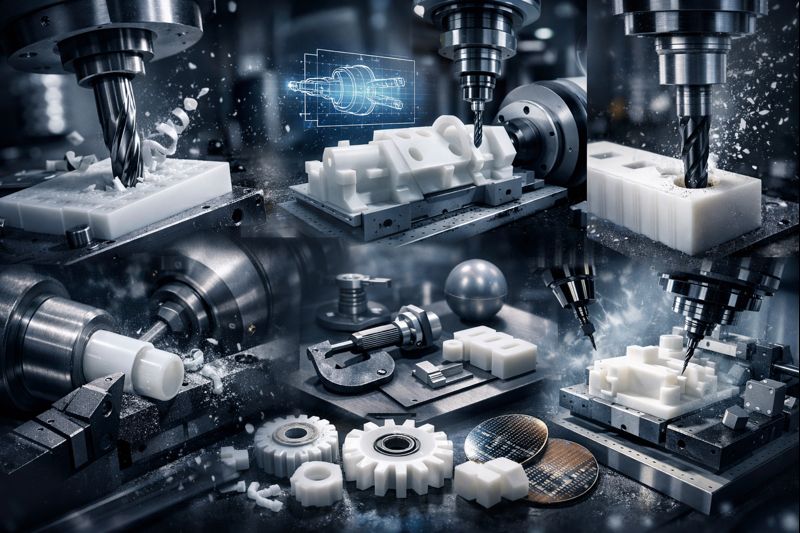
I. POM (Polyoxymethylene / Acetal / Delrin)
1️⃣ What is POM? (From a CNC Machining Perspective)
POM is a high-rigidity, low-friction, self-lubricating engineering plastic.
Its machining behavior is very similar to metal, making it one of the most preferred plastics for CNC machining shops.
📌 CNC engineers often describe POM as:
“Easy to cut, stable, non-sticky to tools, and dimensions are very easy to control.”
2️⃣ Key Material Properties of POM (Impact on Machining)
| Property | Impact on CNC Machining |
|---|---|
| High rigidity & high crystallinity | Stable cutting, minimal vibration |
| Low friction coefficient | Ideal for sliding parts and gears |
| Good dimensional stability | Tight tolerances easily achieved |
| Low moisture absorption | Minimal deformation after machining |
| Self-lubricating | Can replace certain metal components |
⚠️ Note
POM is not resistant to strong acids or strong oxidizing environments, and its thermal stability is limited above 100 °C.
3️⃣ Typical CNC Applications of POM
🔧 Mechanical & Transmission Components
- Precision gears
- Bushings, sleeves
- Sliders, guide components
- Rollers, pulleys
🤖 Automation & Equipment Parts
- Locating pins
- Jigs and fixtures
- Pneumatic component parts
🔬 Semiconductor / Electronic Equipment (Non-Process Core)
- Structural support components
- Sliding parts in non-high-temperature areas
4️⃣ CNC Machining Key Points for POM
🛠 Tool Selection
- Carbide cutting tools
- Sharp cutting edges with positive rake angles
⚙️ Cutting Conditions
- High spindle speed with medium-to-high feed rate
- Dry cutting is acceptable (coolant usually not required)
- Optimal chips are long, continuous, curled chips
📐 Precision Capability
- ±0.02 mm is common
- Precision parts can reach ±0.01 mm
5️⃣ Common POM Machining Issues
| Issue | Cause | Countermeasure |
|---|---|---|
| Burrs | Tool not sharp enough | Improve tool sharpness |
| Surface streaking | Spindle speed too low | Increase RPM |
| Melt adhesion | Feed rate too slow | Increase feed rate |
II. PETP (Polyethylene Terephthalate – Engineering Grade PET)
Also known as PET-P, PETP, or Engineering PET

1️⃣ What is PETP? (CNC Machining Perspective)
PETP is a high-strength, highly dimensionally stable, wear-resistant engineering plastic.
In terms of dimensional accuracy and long-term stability, it often outperforms POM.
📌 CNC engineer’s comment:
“Not as slippery as POM, but the most dimensionally stable—ideal for high-precision parts.”
2️⃣ Material Properties of PETP (Machining Relevance)
| Property | Impact on CNC Machining |
|---|---|
| High crystallinity & rigidity | Minimal elastic recovery after machining |
| Extremely low moisture absorption | Long-term dimensional stability |
| High wear & fatigue resistance | Suitable for continuous motion parts |
| Higher heat resistance than POM | Stable during prolonged use |
| Excellent electrical insulation | Common in electronic equipment |
⚠️ Note
PETP has a higher friction coefficient than POM, resulting in inferior sliding performance.
3️⃣ CNC Applications of PETP
🔬 High-Precision Structural Components
- Precision locating blocks
- Datum / reference plates
- Tight-tolerance jigs
⚙️ Semiconductor / Optoelectronic Equipment
- Insulating structural parts
- Precision spacers
- Support components for non-contact process areas
🏭 Industrial Equipment
- Wear-resistant guide rails
- Support rings and sleeves
4️⃣ CNC Machining Key Points for PETP
🛠 Tooling
- Carbide tools
- Sharper cutting edges recommended to prevent surface tearing
⚙️ Cutting Conditions
- Medium-to-high spindle speed
- Feed rate must not be too slow (to avoid heat buildup)
- Light air cooling or minimal coolant recommended
📐 Precision Capability
- ±0.01 mm can be achieved consistently
- Excellent flatness and parallelism performance
5️⃣ PETP Machining Precautions
| Issue | Description |
|---|---|
| Surface haze | Dull tool or insufficient speed |
| Heat concentration | Excessive dwell time |
| Edge cracking | Improper tool geometry or excessive feed |
III. POM vs PETP – CNC Machining Comparison
| Item | POM | PETP |
|---|---|---|
| Machinability | ⭐⭐⭐⭐⭐ | ⭐⭐⭐⭐ |
| Dimensional stability | ⭐⭐⭐⭐ | ⭐⭐⭐⭐⭐ |
| Friction coefficient | Low (self-lubricating) | Medium |
| Precision limit | ±0.02 ~ ±0.01 mm | ±0.01 mm |
| Suitability for sliding parts | Excellent | Moderate |
| High-precision fixtures | Moderate | Excellent |
IV. Practical CNC Material Selection Guide
👉 Choose POM if your part requires:
- Gears, sliders, moving components
- Low friction
- High productivity and mass production
👉 Choose PETP if your part requires:
- High-precision positioning or datum components
- Maximum dimensional stability
- Semiconductor or optical equipment applications
POM / PETP
CNC Tooling & Cutting Parameter Recommendation Table
(Engineering Specification)
I. Material Machining Positioning (CNC Reference)
| Item | POM (Acetal / Delrin) | PETP (PET Engineering Plastic) |
|---|---|---|
| Crystallinity | High | High |
| Rigidity | High | High (slightly higher than POM) |
| Water Absorption | Low | Extremely low |
| Dimensional Stability | Good | Excellent |
| Coefficient of Friction | Low (self-lubricating) | Medium |
| Typical CNC Application | Sliding / transmission parts | High-precision positioning parts |
II. Tooling Specification
2.1 Tool Material
| Item | Recommendation |
|---|---|
| Tool Material | Solid Carbide |
| Coating | Not recommended (to avoid plastic adhesion) |
| Cutting Edge | Very sharp, positive rake |
| Chip Evacuation | Large flute design |
📌 Engineering Principle
Plastic machining is not a wear issue, but a heat dissipation and chip evacuation issue.
2.2 End Mill Geometry Recommendation
| Item | Recommended Value |
|---|---|
| Number of Flutes | 1–2 flutes |
| Rake Angle | +10° to +20° |
| Helix Angle | 30°–45° |
| Tool Tip | Micro chamfer or R ≤ 0.2 |
III. CNC Cutting Parameters (Reference)
3.1 End Milling
▶ POM Milling
| Item | Recommended Range |
|---|---|
| Cutting Speed (Vc) | 300 – 600 m/min |
| Spindle Speed (Ø6) | 16,000 – 30,000 rpm |
| Feed per Tooth (fz) | 0.05 – 0.20 mm/tooth |
| Axial Depth (ap) | 0.5 – 2.0 × D |
| Radial Width (ae) | 10 – 40% D |
| Cooling | Dry / Air |
▶ PETP Milling
| Item | Recommended Range |
|---|---|
| Cutting Speed (Vc) | 200 – 400 m/min |
| Spindle Speed (Ø6) | 12,000 – 22,000 rpm |
| Feed per Tooth (fz) | 0.04 – 0.15 mm/tooth |
| Axial Depth (ap) | 0.5 – 1.5 × D |
| Radial Width (ae) | 10 – 30% D |
| Cooling | Air / Minimal coolant |
📌 Key Differences
- POM allows aggressive cutting; PETP requires stable cutting
- Avoid tool dwell in PETP to prevent heat accumulation
3.2 Drilling
| Item | POM | PETP |
|---|---|---|
| Drill Type | Standard or plastic drill | Plastic-specific drill |
| Point Angle | 90°–118° | 90° |
| Speed | High | Medium–High |
| Feed | Medium–High | Medium |
| Peck Drilling | Recommended | Mandatory |
| Cooling | Dry | Air |
3.3 Turning
| Item | POM | PETP |
|---|---|---|
| Insert Material | Carbide | Carbide |
| Nose Radius | R0.2 – R0.4 | R0.2 |
| Cutting Speed | High | Medium |
| Feed Rate | 0.1 – 0.3 mm/rev | 0.08 – 0.2 mm/rev |
| Cooling | Dry | Air |
IV. Accuracy & Geometric Capability
| Item | POM | PETP |
|---|---|---|
| General Tolerance | ±0.05 mm | ±0.03 mm |
| Precision Machining | ±0.02 mm | ±0.01 mm |
| Flatness | Good | Excellent |
| Parallelism | Good | Excellent |
| Post-machining Deformation | Low | Extremely low |
V. Critical Process Controls
5.1 Thermal Control (Most Critical)
- Avoid low feed + high RPM
- Avoid tool dwell at the same position
- Deep holes must be drilled with step retraction for heat release
5.2 Fixturing Recommendation
| Item | Specification |
|---|---|
| Clamping Force | Lower than metal parts |
| Padding | Soft pads recommended |
| Positioning | Surface contact preferred over line contact |
VI. Failure Modes & Countermeasures
| Defect | Material | Cause | Solution |
|---|---|---|---|
| Tool adhesion | POM | Feed too slow | Increase feed |
| Surface tearing | PETP | Dull tool | Replace sharp tool |
| Edge cracking | PETP | Heat concentration | Step machining |
| Dimensional drift | Both | Clamping deformation | Reduce clamping force |
VII. Material Selection Guide
- Sliding / transmission / high-efficiency mass production → POM
- High precision / datum parts / semiconductor equipment → PETP
#POM #Acetal #Delrin #PETP #PETEngineeringPlastic #EngineeringPlastic #HighRigidity #LowMoistureAbsorption #DimensionalStability #SelfLubricating #HighPrecisionParts #CNC #Milling #EndMilling #Turning #Drilling #5AxisMachining #PrecisionMachining #HighSpeedCutting #DryMachining #MinimalCoolant #PeckDrill #ToolThermalControl #Carbide #SharpTool #PositiveRakeAngle #TipRadius #FluteNumber1to2 #HelixAngle #LargeChipGullets #UncoatedTool #PlasticTool #CuttingSpeedVc #SpindleRPM #FeedPerTooth #AxialDepthAp #RadialWidthAe #LinearSpeed #FeedRate #CoolingMethod #HighSpeedMachining #StableMachining #Tolerance #±0.05mm #±0.03mm #PrecisionTolerance #±0.02mm #±0.01mm #Flatness #Parallelism #PostMachiningDeformation #ThermalControl #FixtureDesign #SurfaceContact #ClampingForceControl #Burring #SurfaceRoughness #CornerCracks #DimensionalDrift #ToolDulling #HeatConcentration #SlidingParts #TransmissionParts #HighPrecisionPositioning #SemiconductorParts #DatumParts #HighVolumeProduction
Yongyi Technology Co., Ltd.

location_on 42756 No. 188-9, Section 1, Dafeng Road, Tanzi District, Taichung City, Taiwan
email yongyi-sales@umail.hinet.net
email justinwu6767@gmail.com