
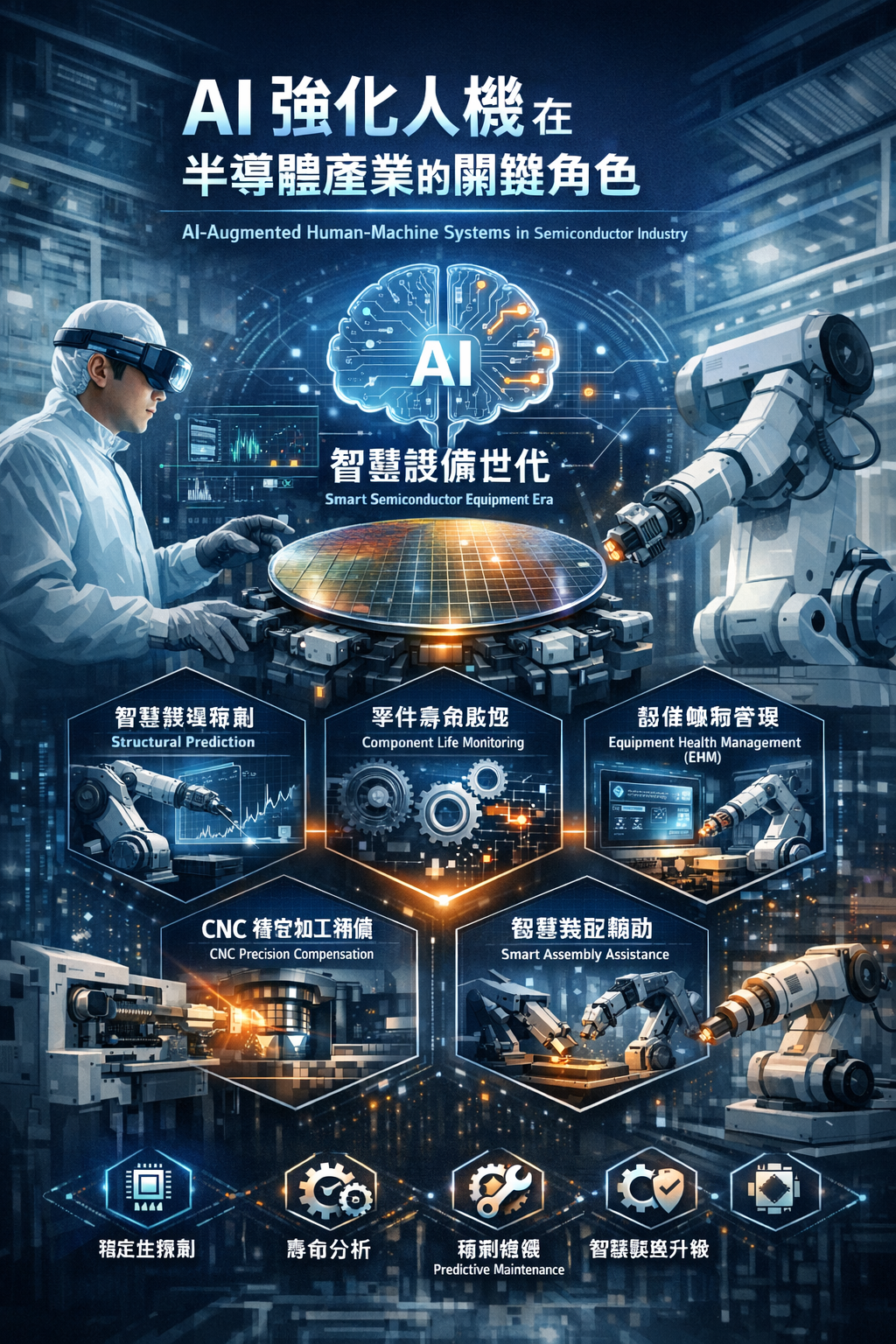
AI-Augmented Human-Machine Systems:
The Core Engine of Future Industrial Competitiveness
Under the wave of Industry 4.0 and smart manufacturing, the traditional model of
“humans operating machines” is evolving into:
👉 Human × AI × Machine Collaborative Decision-Making
AI is no longer just a tool — it has become:
✔ A decision-support partner
✔ A capability amplifier
✔ A digital carrier of experience
Ultimately forming:
👉 Human-in-the-Loop Intelligent Decision Systems
1. What is AI-Augmented Human-Machine?
AI-Augmented Human-Machine Systems refer to:
The use of AI to enhance human capabilities in operating, analyzing, deciding, and controlling machinery.
Where:
🔹 Humans provide experience & strategy
🔹 AI provides data & prediction
🔹 Machines provide execution & precision
Creating a tri-integrated intelligent collaboration model.
2. Difference from Traditional Automation
| Aspect | Traditional Automation | AI-Augmented Human-Machine |
|---|---|---|
| Decision Method | Pre-programmed | Real-time intelligent analysis |
| Operation Mode | Human → Machine | Human ↔ AI ↔ Machine |
| Flexibility | Low | High |
| Learning Ability | None | Continuous optimization |
| Production Adaptability | Fixed process | Self-adjusting |
3. Value in Manufacturing
Especially in CNC precision machining / semiconductor equipment / advanced manufacturing, AI enhances:
1️⃣ Digitalization of Operational Experience
Senior engineers’ know-how → AI modeling
Preventing knowledge gaps
Examples:
• Tool life prediction
• Machining parameter optimization
• Abnormal vibration detection
2️⃣ Real-Time Machining Decision Support
AI can analyze:
✔ Temperature variation
✔ Spindle load
✔ Material variability
✔ Tool wear
And provide:
👉 Optimal cutting recommendations
👉 Compensation strategies
👉 Predictive maintenance
3️⃣ Improved Precision & Stability
AI assists in:
• Micron-level error prediction
• Process drift correction
• Yield optimization
Allowing “master-level” expertise to be standardized and replicated.
4️⃣ Human Capability Amplification
AI enables:
Beginner engineers ≈ Intermediate level
Intermediate engineers ≈ Experts
Shortening learning curves and strengthening overall production capability.
4. Applications in High-End Equipment Industries
Semiconductor Equipment
• Intelligent calibration
• Vacuum chamber condition prediction
• Micro-vibration analysis
Optical & Precision Instruments
• Microstructure machining compensation
• Thermal deformation prediction
Automation Equipment
• Mechanical wear early warning
• Dynamic path optimization
5. Ultimate Goal of AI-Augmented Human-Machine
Not to replace humans — but to:
👉 Amplify human expertise
👉 Extend engineering intuition
👉 Reduce human-induced risks
Forming:
Digital Craftsmanship Systems
Transforming manufacturing from:
Technology-intensive → Intelligence-intensive
✔ Experience becomes data
✔ Processes continuously self-optimizing
6. Future Trends
AI-Augmented Human-Machine will drive:
🔹 “Fewer but more capable” workforce instead of full unmanned production
🔹 Digitalized knowledge transfer
🔹 Real-time manufacturing decision-making
🔹 Standardization of ultra-precision machining
AI-Augmented Human-Machine Systems in the Semiconductor Industry
Driving the Smart Semiconductor Equipment Era
As advanced semiconductor processes move toward 3nm, 2nm, and even smaller nodes, equipment precision requirements have reached:
👉 Nanometer-level stability
👉 Ultra-low vibration
👉 High consistency
Traditional automation is no longer sufficient to manage such complex processes.
Therefore, the global equipment industry is moving toward:
AI-Augmented Human-Machine Systems (AI-Augmented HMS)
Integrating engineering experience, equipment data, and precision mechanisms into an intelligent collaborative system.
1. Core Challenges in Semiconductor Equipment
Advanced equipment faces four major challenges:
1️⃣ Extremely high process sensitivity
Even minor deviations can cause:
- Yield reduction
- Alignment errors
- Process instability
2️⃣ Highly precise equipment structures
Typical critical components include:
- Vacuum chambers
- Wafer handling mechanisms
- Gas distribution systems
- Precision fixtures
- Micro-positioning modules
Performance depends not only on machining accuracy but also on:
👉 Long-term stability
👉 Temperature-induced deformation control
👉 Dynamic vibration behavior
3️⃣ Human expertise is difficult to replicate
Senior equipment engineers can detect through experience:
- Structural micro-deformations
- Friction anomalies
- Process drift
But such know-how is:
❌ Hard to quantify
❌ Difficult to transfer
4️⃣ Extremely high cost of downtime
Unexpected downtime may result in:
👉 Significant financial losses
👉 Production interruptions
👉 Risk to customer delivery schedules
2. How AI-Augmented Human-Machine Systems Transform Semiconductor Equipment
AI’s role is not to replace engineers, but to:
- Digitize engineering intuition
- Form intelligent equipment decision-making systems
3. AI-Augmented Application Scenarios
1️⃣ Predicting mechanical stability
AI can analyze:
- Micro-vibrations
- Structural stress changes
- Long-term fatigue trends
Applied to:
✔ Vacuum chamber structural components
✔ Wafer handling arms
✔ Precision support platforms
Enabling early prediction of:
👉 Structural deformation risks
👉 Precision drift
2️⃣ Predicting equipment component lifetime
AI can monitor:
- Surface wear
- Friction changes
- Thermal effects
To forecast:
👉 Optimal replacement timing
👉 Maintenance cycles
Reducing the risk of unexpected downtime.
3️⃣ Intelligent CNC machining compensation
At the component manufacturing stage, AI can assist with:
- Tool wear compensation
- Micron-level dimension prediction
- Thermal deformation correction
Ensuring:
✔ High consistency
✔ High stability
✔ Batch quality control
4️⃣ Smart assembly assistance
During assembly, AI can analyze:
- Contact surface stress
- Alignment precision
- Installation deviations
Providing:
👉 Assembly correction recommendations
👉 Precision optimization strategies
5️⃣ Equipment Health Management (EHM)
By establishing an Equipment Health Model, AI enables:
- Predictive maintenance
- Anomaly trend detection
- Long-term performance tracking
4. Value for the Semiconductor Equipment Supply Chain
AI-Augmented HMS allows equipment component suppliers to move from:
“Process providers” → Smart manufacturing partners
Offering:
- Stability data support
- Process consistency optimization
- Structural lifetime analysis
This is especially important for leading equipment companies such as:
- ASML
- Applied Materials
- Lam Research
- Tokyo Electron
5. AI-Augmented Human-Machine Systems × Precision Component Manufacturing
For the CNC precision machining industry, AI enables:
Manufacturing upgrades – shifting the focus from:
Machining precision competition →
👉 Stability competition
👉 Lifetime competition
👉 Structural reliability competition
Quality management upgrades:
- AI can build process stability models
- Predict batch consistency
- Track long-term performance
6. Future Development Trends
AI-Augmented Human-Machine Systems will become:
The next-generation standard for semiconductor equipment design.
Future equipment will feature:
✔ Self-diagnosis capabilities
✔ Self-optimization capabilities
✔ Digitized experiential knowledge
Creating a Smart Equipment Ecosystem.
7. Strategic Implications
For equipment supply chain companies, AI-Augmented HMS is more than a technology upgrade; it is:
👉 A gateway to the high-end supply chain
👉 A foundation for long-term collaboration trust
👉 A key to enhancing technical value-added
#AIEnhancesHumanMachineCollaboration #AIAugmentedManufacturing #SmartSemiconductorEquipment #SmartManufacturing #SmartEquipment #HumanMachineCollaborativeDecisionMaking #HumanInTheLoop #SmartFactory #IndustrialAI #IntelligentSemiconductorEquipment #SemiconductorEquipmentAI #EquipmentHealthMonitoring #PredictiveMaintenance #PredictiveMaintenance #ProcessStabilityControl #HighPrecisionEquipment #SmartVacuumCavity #WaferTransferSystem #AICNCMachining #SmartMachiningCompensation #PrecisionMachiningAI #MicronLevelMachiningControl #MachiningStabilityAnalysis #ToolLifePrediction #Process
Yong Yi Technology Co., Ltd.
Location: No. 188-9, Section 1, Dafeng Road, Tanzih District, Taichung City, Taiwan 42756, China
Call: +886-4-25341382
Ring Volume: +886-4-25341847
Email: yongyi-sales@umail.hinet.net
Email: justinwu6767@gmail.com