
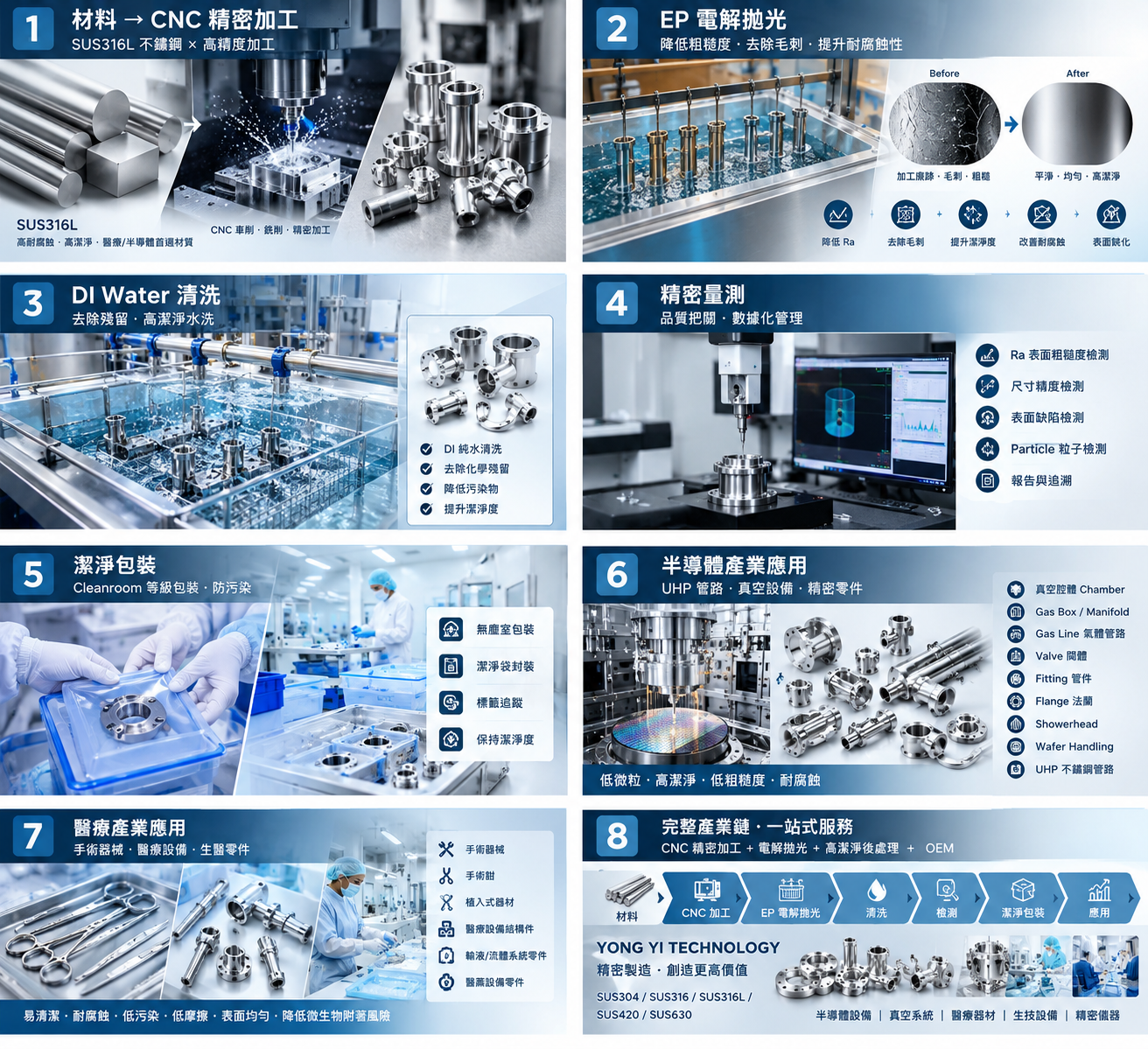
Electropolishing (EP) is valuable for the semiconductor and medical industries, and is especially suitable for precision parts made of stainless steel such as #SUS304, #SUS316, #SUS316L, #SUS420, and #SUS17-4PH.
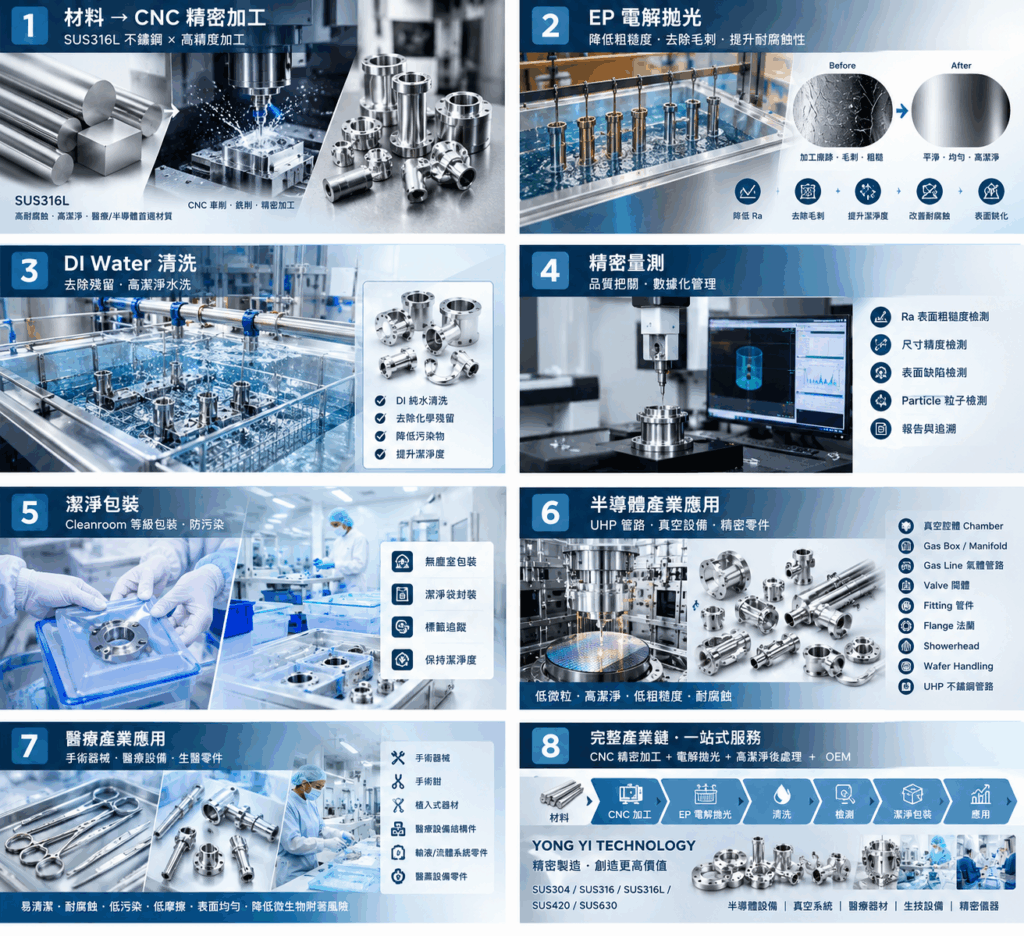
Electropolishing (EP) Applications and Benefits in the Semiconductor and Medical Industries
Electropolishing (EP) is highly valuable in both the semiconductor and medical industries, particularly for precision stainless-steel components made from SUS304, SUS316, SUS316L, SUS420, SUS17-4PH, and other stainless-steel grades.
EP is not simply a process for making a surface shiny. Its core benefits include reducing surface roughness, removing micro-burrs and contaminants, improving cleanliness, enhancing corrosion resistance, and improving surface passivation.
1. Why Is EP Used in the Semiconductor Industry?
Semiconductor equipment places strong emphasis on:
Low Particle Generation + High Cleanliness + Low Surface Roughness (Low Ra) + Corrosion Resistance + Low Contamination
Typical applications include:
- Vacuum Chambers
- Gas Boxes / Gas Manifolds
- Gas Lines
- Valves
- Fittings
- Flanges
- Showerheads / Gas Distribution Plates
- Wafer Handling Components
- Vacuum Components
- SUS316L Precision CNC Components
Electropolishing preferentially dissolves microscopic high points on the metal surface, thereby improving surface smoothness and cleanliness. Studies have also shown that electropolished 316L stainless steel can provide improved corrosion performance and reduced particle generation in environments involving specialty gases used in semiconductor manufacturing.
Major Benefits of EP for Semiconductor Equipment
| Function | Value for Semiconductor Equipment |
|---|---|
| Reduce Ra | Reduces particle and contaminant adhesion |
| Remove Micro-Burrs | Helps prevent metal particles from detaching |
| Remove Machining Residues | Improves component cleanliness |
| Surface Passivation | Improves corrosion resistance |
| Reduce Surface Reactivity | Helps reduce adsorption of gases and chemicals |
| Improve Cleanability | Makes cleaning and flushing easier |
| Improve Vacuum Surface Quality | Beneficial for high-cleanliness vacuum components |
| Remove Some Machining-Affected Layers | Helps reduce surface defects caused by machining |
For semiconductor high-purity gas piping and components, EP is often combined with cleanroom cleaning, inspection, and clean packaging. Electropolishing is also widely used for UHP (Ultra High Purity) stainless-steel tubing and components.
2. Why Is EP Used in the Medical Industry?
Medical devices place greater emphasis on:
Easy Cleaning + Corrosion Resistance + Low Contamination + Low Friction + Uniform Surface Finish + Reduced Risk of Microbial Adhesion
Typical applications include:
- Surgical Instruments
- Surgical Forceps
- Medical Fixtures
- Selected Components for Implantable Devices
- SUS316L Medical Components
- Medical Equipment Structural Components
- Biomedical Equipment Tubing
- Infusion / Fluid System Components
- Pharmaceutical Equipment Components
Electropolishing can make stainless-steel surfaces smoother while producing a more stable passive surface, which can be beneficial for the cleanability and corrosion resistance requirements of medical devices.
SUS316L is also widely used in medical and biomedical applications.
A 2026 study concerning metallic orthopedic medical devices indicated that EP performed in accordance with ASTM B912 typically removes approximately 5–10 μm of surface material, with greater material removal possible when required. However, the actual material removal must be controlled according to the component, material, geometry, and specified requirements.
3. The Most Useful Advantages of EP
From the perspective of Yong Yi Technology’s precision CNC machining + integrated post-processing services, the greatest value of EP is not simply surface appearance, but its ability to improve the functional quality of precision components.
① Improving Surface Quality After CNC Machining
A typical process can be:
CNC Turning → CNC Milling → Deburring → Electropolishing → Cleaning → Inspection → Clean Packaging
This process can further address microscopic burrs, machining residues, and surface contamination generated during CNC machining.
② Particularly Suitable for Complex Geometries
Mechanical polishing is limited by the accessibility of grinding wheels, polishing tools, and other mechanical equipment.
Electropolishing, on the other hand, uses an electrochemical process to treat the metal surface and can therefore be useful for components such as:
- Small Holes
- Grooves
- Complex Curved Surfaces
- Tubular Components
- Valve Bodies
- Flanges
- Precision Mechanical Components
However, it is important to note that not every internal hole, deep hole, or shielded area will receive completely uniform electropolishing. Component geometry, fixturing, and current distribution can all affect the final result.
4. How Low Can the Surface Roughness Ra Be After EP?
It is not appropriate to simply state that:
“Electropolishing can always achieve Ra 0.05 μm.”
Actual results depend on many factors, including:
- Initial CNC Surface Finish
- Material
- SUS304 / SUS316L and Other Stainless-Steel Grades
- Current Density
- Electrolyte
- Temperature
- Electropolishing Time
- Component Geometry
- Pre-treatment
In one 316L experimental study, an initial surface roughness of approximately Ra 0.5–0.8 μm was reduced to approximately Ra 0.035 μm under appropriate electropolishing conditions.
Therefore, for practical customer specifications, it is more appropriate to state:
Electropolishing can significantly reduce surface roughness. The achievable Ra value depends on the material, pre-machining surface condition, component geometry, and specified electropolishing process.
Rather than guaranteeing that every component will achieve a specific Ra value.
5. What Is the Approximate Cost of Electropolishing?
It is important to understand that:
There is no fixed “price per kilogram” for electropolishing.
EP pricing is generally determined according to:
Material + Dimensions + Surface Area + Weight + Geometry + Quantity + Pre-treatment + Required Ra + Cleaning + Cleanroom Packaging + Inspection
Publicly available pricing information in Taiwan may provide reference prices for conventional stainless-steel polishing. For example, some Taiwanese suppliers have published 2024 pricing for conventional stainless-steel plate polishing. However, these prices refer to mechanical polishing rather than semiconductor-grade electropolishing, so they should not be directly used as a semiconductor EP quotation.
Taiwanese EP suppliers generally need to review the customer’s drawings, material, dimensions, quantity, and quality requirements before providing a quotation. A typical process is:
Product Consultation → Process Planning → Quotation → Trial Production → Quality Confirmation → Production
Suggested Preliminary EP Price Ranges
The following figures can be used only as rough quotation references for preliminary estimation, rather than fixed market prices:
| Component Type | Approximate EP Price / Piece |
|---|---|
| Small SUS304 / SUS316L CNC Components | Approximately NT$100–500 |
| Medium Precision Components | Approximately NT$300–1,500 |
| Complex Valve Bodies / Flanges | Approximately NT$800–3,000 |
| Semiconductor Precision Components | Approximately NT$1,000–5,000+ |
| Large Chambers / Structural Components | Approximately NT$3,000–20,000+ |
| Semiconductor-Grade EP + High-Cleanliness Cleaning | Quoted Separately |
| EP + Cleanroom Cleaning + Clean Packaging + Inspection | May add several thousand to tens of thousands of NTD |
The most important cost factors are often surface area, component complexity, and quality requirements—not simply material weight.
6. Semiconductor-Grade EP vs. General Industrial EP
This distinction is particularly important for CNC OEM manufacturing.
General Industrial EP
For example:
SUS304 → Electropolishing → Bright Surface Finish
The primary requirements may include:
- Surface Appearance
- Gloss
- Deburring
- Corrosion Resistance
- Smooth Surface Finish
Therefore, the overall cost is generally lower.
Semiconductor-Grade EP
For example:
SUS316L → CNC Machining → Deburring → Electropolishing → DI Water Cleaning → High-Cleanliness Cleaning → Ra Inspection → Particle Control → Cleanroom Packaging
The focus shifts toward:
Ra + Particle Control + Cleanliness + Passivation + Traceability + Documentation
Consequently, the overall cost can be significantly higher.
Some semiconductor EP suppliers also provide ISO Class 4 / 5 / 7 cleanroom cleaning, as well as documentation associated with semiconductor manufacturing requirements and SEMI-related specifications.
7. Recommended Positioning for Yong Yi Technology
If Yong Yi Technology incorporates EP into its CNC machining services, the service can be positioned as follows:
CNC Precision Machining + Electropolishing
Precision CNC Machining × Stainless Steel Electropolishing × High-Cleanliness Cleaning
Yong Yi Technology provides precision CNC machining of stainless-steel components made from SUS304, SUS316, SUS316L, SUS420, SUS630, and other materials. We integrate electropolishing (EP), passivation, cleaning, surface inspection, and clean packaging to provide comprehensive manufacturing solutions for semiconductor equipment, vacuum systems, medical devices, biomedical equipment, precision instruments, and high-cleanliness process equipment.
This positioning provides greater OEM value than simply promoting “stainless-steel electropolishing.”
SEO Keywords
#Electropolishing #EPProcessing #StainlessSteelElectropolishing #SUS316LElectropolishing #SUS304Electropolishing #SemiconductorComponents #SemiconductorEquipmentComponents #SemiconductorHighCleanlinessMachining #MedicalDeviceMachining #MedicalStainlessSteelMachining #HighCleanlinessComponents #PrecisionCNCMachining #CNCPrecisionComponents #VacuumComponents #SemiconductorVacuumComponents #SurfaceTreatment #StainlessSteelSurfaceTreatment #PassivationTreatment #CleanroomPackaging
Yongyi Technology Co., Ltd.

location_on 42756 No. 188-9, Section 1, Dafeng Road, Tanzi District, Taichung City, Taiwan
email yongyi-sales@umail.hinet.net
email justinwu6767@gmail.com