
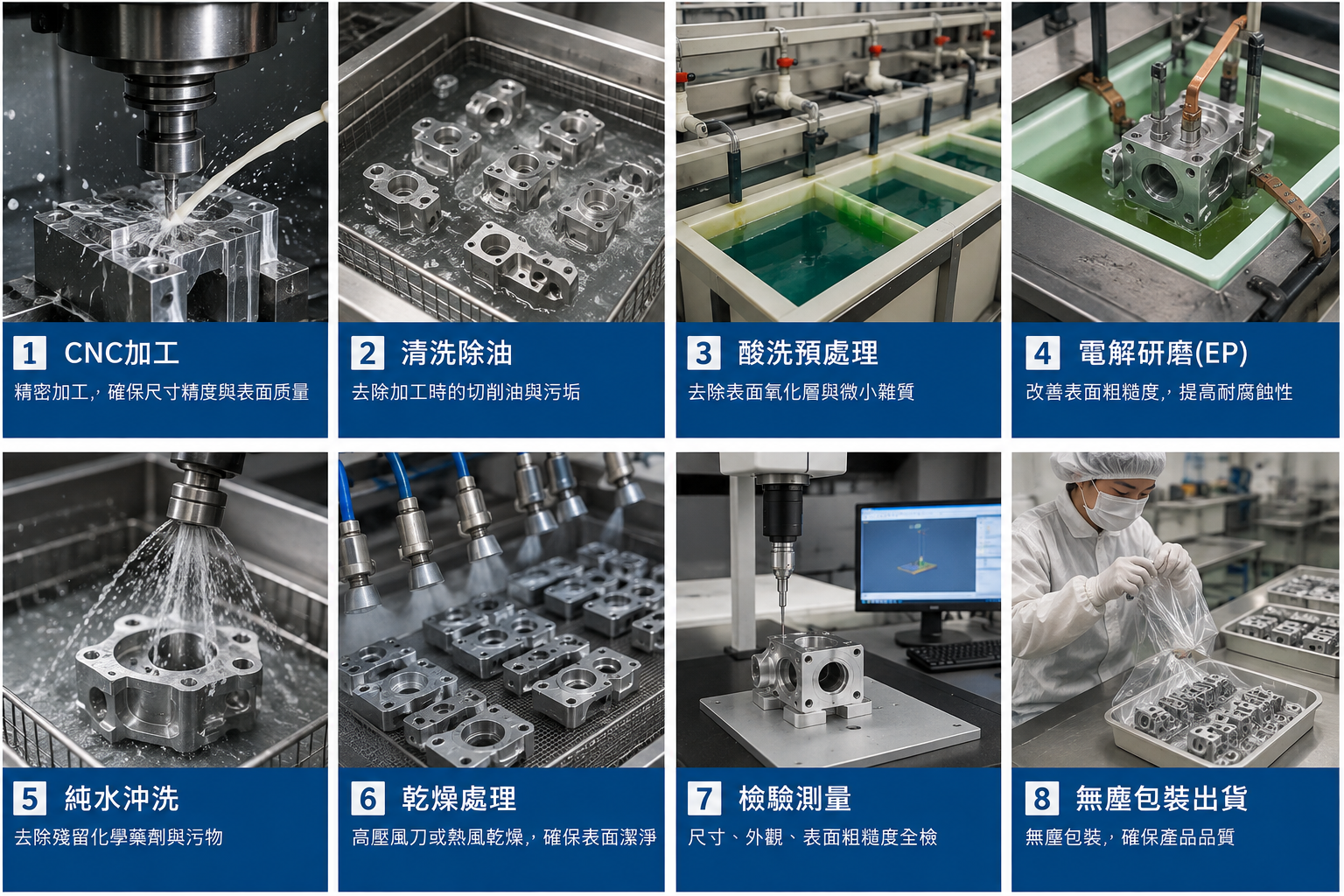
Electropolishing (EP), used in the CNC industry, is a non-contact electrochemical surface treatment technology. It mainly uses direct current and electrolyte to preferentially dissolve the microscopic protrusions on the metal surface, achieving smoothing, deburring, removal of contaminant layers, and improved corrosion resistance and cleanliness. Therefore, it is also known as reverse plating.
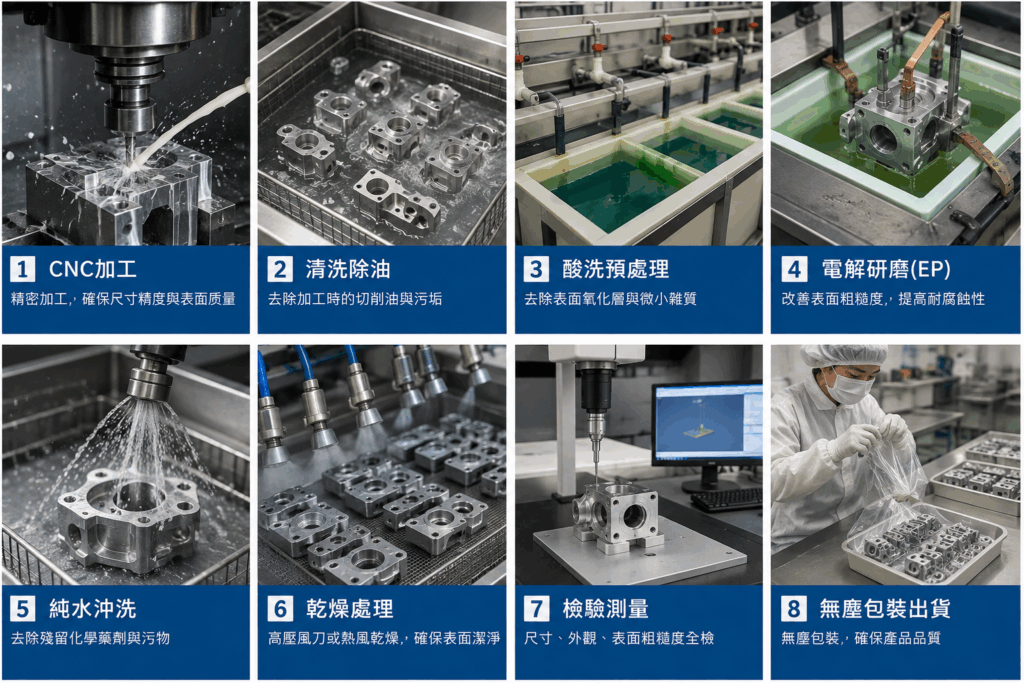
Electropolishing Equipment for the CNC Industry
Introduction, Process Applications, and Key Advantages
Electropolishing (EP) is a non-contact electrochemical surface finishing process widely used in the CNC machining industry. By applying direct current (DC) in a specially formulated electrolyte, microscopic peaks on a metal surface are selectively dissolved, resulting in a smoother, cleaner, and more corrosion-resistant finish. Because material is removed from the surface rather than deposited, electropolishing is often referred to as reverse electroplating.
It is an ideal post-processing solution for precision CNC machined components made from stainless steel, aluminum alloys, titanium, nickel alloys, and other high-performance metals.
Electropolishing Equipment
A complete industrial electropolishing system typically consists of the following components:
1. Electrolyte Tank
- Acid-resistant PP or PVC tank
- Electrolyte circulation system
- Temperature control unit
2. DC Power Supply
- Adjustable voltage
- Adjustable current
- Current density control
3. Cathode System
- Stainless steel cathodes
- Titanium cathodes
4. Workpiece Fixture
- Conductive clamping fixtures
- Designed to minimize contact marks
- Ensures stable electrical conductivity
5. Cleaning System
- DI (Deionized) water rinse
- Ultrasonic cleaning
- Neutralization process
6. Drying System
- Hot-air drying
- Vacuum drying
Electropolishing Process Flow
Raw Material

↓

CNC Machining

↓

Degreasing & Cleaning

↓

Acid Pretreatment

↓

Electropolishing (EP)

↓

DI Water Rinse

↓

Neutralization

↓

Final DI Water Cleaning

↓

Drying

↓

Surface Inspection

↓

Surface Roughness Measurement (Ra)

↓

Packaging & Shipment
Principle of Electropolishing
After CNC machining, metal surfaces typically contain:
- Tool marks
- Burrs
- Micro-cracks
- Residual machining stress
- Free iron contamination
- Embedded machining debris
During electropolishing, the workpiece serves as the anode, where microscopic surface peaks dissolve faster than valleys.
This electrochemical process produces:
- Smooth surfaces
- Bright metallic finish
- Uniform passive oxide layer
- Improved corrosion resistance
- Lower surface roughness (Ra)
Major Improvements After CNC Machining
1. Micro Deburring
Electropolishing effectively removes microscopic burrs from:
- Precision holes
- Cross-drilled holes
- Narrow grooves
- Internal threads
- Complex internal geometries
These areas are often difficult or impossible to finish using conventional mechanical polishing.
2. Reduced Surface Roughness
| Surface Finish | Typical Ra |
|---|---|
| Standard CNC Machining | 0.8–1.6 μm |
| Precision CNC Machining | 0.4–0.8 μm |
| Electropolished Surface | 0.1–0.4 μm |
| Mirror Electropolishing | <0.1 μm |
Lower surface roughness improves:
- Fluid flow efficiency
- Particle resistance
- Cleanability
- Surface appearance
Five Major Advantages of Electropolishing
1. Superior Corrosion Resistance
Electropolishing:
- Removes free iron contamination
- Enriches chromium concentration on the surface
- Forms a uniform passive oxide layer
This significantly improves the corrosion resistance of:
- SUS304
- SUS316
- SUS316L
2. Enhanced Surface Cleanliness
Electropolishing removes:
- Machining oil residues
- Metallic particles
- Surface contaminants
- Embedded impurities
This makes EP particularly suitable for:
- Semiconductor equipment
- Medical devices
- Pharmaceutical equipment
- Food processing machinery
3. Reduced Bacterial Adhesion
A smoother surface provides fewer locations for bacteria to accumulate.
Therefore, electropolishing is widely used in:
- Medical instruments
- Biotechnology equipment
- Food and beverage processing systems
- Pharmaceutical manufacturing
4. Improved Fatigue Performance
By eliminating microscopic stress concentration points and surface imperfections, electropolishing can improve:
- Fatigue strength
- Service life
- Reliability under cyclic loading
5. Excellent Surface Appearance
Electropolishing produces:
- Bright metallic finish
- Uniform gloss
- Consistent surface texture
- Superior cosmetic appearance
Compared with mechanical polishing, electropolishing offers more uniform results on complex geometries.
Applications in CNC Manufacturing
Semiconductor Industry
Typical components include:
- Vacuum Chambers
- Gas Distribution Plates
- Shower Heads
- Wafer Holders
- End Effectors
- Precision Mounting Brackets
Benefits:
- Reduced particle generation
- Higher cleanliness levels
- Improved vacuum compatibility
- Better contamination control
Medical Industry
Typical components include:
- Surgical Instruments
- Bone Screws
- Dental Components
- Endoscope Parts
- Orthopedic Implants
Advantages:
- Enhanced biocompatibility
- Easier sterilization
- Improved corrosion resistance
Food Processing Equipment
Common applications include:
- SUS316 sanitary piping
- Hygienic valves
- Mixing equipment
- Filling systems
Benefits:
- Easier cleaning
- Reduced bacterial growth
- Compliance with hygienic standards
Aerospace Industry
Typical materials:
- Titanium Alloys
- Inconel
- High-strength Stainless Steel
Benefits:
- Better surface integrity
- Enhanced corrosion resistance
- Improved fatigue life
- Reduced stress concentration
Suitable Materials for Electropolishing
| Material | Suitability |
|---|---|
| SUS304 | ★★★★★ |
| SUS316 | ★★★★★ |
| SUS316L | ★★★★★ |
| SUS303 | ★★★★☆ |
| Aluminum Alloys | ★★★☆☆ |
| Titanium Alloys | ★★★★★ |
| Inconel | ★★★★★ |
| Nickel Alloys | ★★★★★ |
Mechanical Polishing vs. Electropolishing
| Feature | Mechanical Polishing | Electropolishing |
|---|---|---|
| Micro Deburring | Fair | Excellent |
| Internal Hole Finishing | Difficult | Excellent |
| Surface Uniformity | Moderate | Excellent |
| Corrosion Resistance | Moderate | Excellent |
| Cleanliness | Moderate | Excellent |
| Abrasive Residue | Possible | None |
| Semiconductor Applications | Limited | Highly Recommended |
Recommended Manufacturing Workflow
Raw Material

↓

CNC Rough Machining

↓

Precision CNC Machining

↓

Deburring

↓

Ultrasonic Cleaning

↓

Electropolishing (EP)

↓

DI Water Cleaning

↓

Drying

↓

Surface Roughness Inspection

↓

Dimensional Inspection

↓

Cleanroom Packaging

↓

Shipment
Why Electropolishing is Essential for Precision CNC Manufacturing
Electropolishing has become a critical finishing process in modern precision manufacturing because it simultaneously improves surface quality, corrosion resistance, cleanliness, and product reliability. It is particularly valuable for industries requiring ultra-clean and high-performance components, including:
- Semiconductor Equipment
- Precision CNC Components
- Medical Devices
- Aerospace Components
- Optical Equipment
- Food Processing Machinery
- Vacuum Systems
- High-Purity Industrial Equipment
When integrated with high-precision CNC machining (tolerances as tight as ±0.005 mm), electropolishing significantly enhances overall product quality, extends component service life, and increases the added value of precision-manufactured parts.
#CNC加工 #CNC精密加工 #精密加工 #五軸加工 #CNC車銑加工 #金屬加工 #機械加工 #精密製造 #OEM加工 #客製化零件 #精密零件 #電解研磨 #EP電解研磨 #表面處理 #去毛邊 #鏡面拋光 #不鏽鋼加工 #鋁合金加工 #鈦合金加工 #半導體設備零件 #真空設備零件 #光學零件 #醫療器材零件 #航太零件 #自動化設備 #機器人零件 #工業設備零件 #精密治具 #治具加工 #精密機械 #智慧製造 #工業4_0 #高精度加工 #微細加工 #CNC銑床 #CNC車床 #零件製造 #客製化加工 #精密工程 #台灣製造
#CNCMachining #PrecisionMachining #CustomMachining #PrecisionEngineering #CNCManufacturing #OEMParts #CustomParts #PrecisionComponents #Electropolishing #SurfaceFinishing #MetalMachining #StainlessSteelMachining #AluminumMachining #TitaniumMachining #FiveAxisMachining #CNCMilling #CNCTurning #Deburring #MirrorFinish #SemiconductorEquipment #SemiconductorParts #VacuumComponents #MedicalDevices #MedicalComponents #AerospaceComponents #AutomationEquipment #RoboticsParts #OpticalComponents #IndustrialManufacturing #SmartManufacturing #Industry40 #HighPrecision #MicroMachining #MechanicalEngineering #ManufacturingTechnology #CleanroomComponents #VacuumTechnology #AdvancedManufacturing #MadeInTaiwan #TaiwanCNC
詠翊科技有限公司

location_on 42756 台灣台中市潭子區大豐路一段188-9號
email yongyi-sales@umail.hinet.net
email justinwu6767@gmail.com