
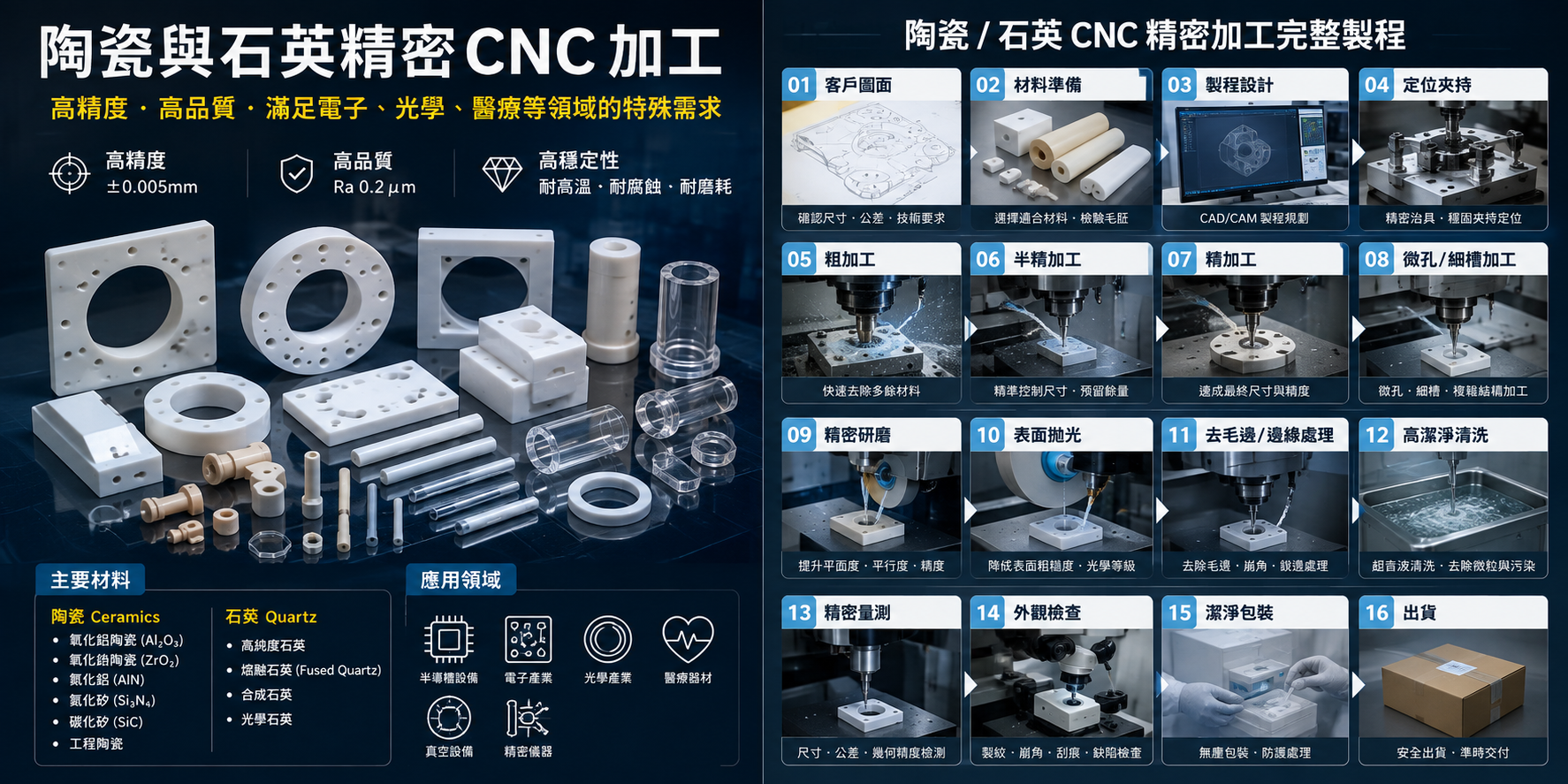
Precision Ceramic & Quartz CNC Machining
Ceramics and quartz are hard, brittle materials. Compared with conventional metals such as aluminum alloys and stainless steel, their machining processes require greater attention to tool selection, spindle stability, cutting parameters, cooling methods, stress control, and dimensional inspection.
Through precision CNC machining, drilling, milling, grinding, polishing, and precision inspection, ceramic and quartz materials can be manufactured into complex, high-precision components that meet the demanding requirements of industries such as semiconductor equipment, electronics, optoelectronics, optics, medical devices, vacuum equipment, precision instruments, and other high-tech applications.
1. Major Materials for Precision Ceramic & Quartz Machining
1.1 Ceramic Materials
Common ceramic materials include:
- Alumina (Al₂O₃)
- Zirconia (ZrO₂)
- Aluminum Nitride (AlN)
- Silicon Nitride (Si₃N₄)
- Silicon Carbide (SiC)
- High-Purity Ceramics
- Engineering Ceramics
Different ceramic materials have different hardness, fracture toughness, coefficient of thermal expansion, wear resistance, and high-temperature resistance. Therefore, the machining method and cutting strategy must be selected according to the specific material properties.
1.2 Quartz Materials
Quartz offers excellent properties including:
- High Purity
- High-Temperature Resistance
- Chemical Resistance
- Low Thermal Expansion
- Electrical Insulation
- Excellent Optical Properties
Quartz is therefore widely used in:
Semiconductor manufacturing equipment, wafer processing, optical equipment, vacuum systems, laboratory equipment, and high-purity process components.
2. Complete Precision CNC Machining Process for Ceramics & Quartz
The overall manufacturing workflow can be structured as:
Customer Drawing → Material Verification → Process Engineering → CNC Programming → Raw Material Preparation → Precision Fixturing → Rough Machining → Semi-Finishing → Finish Machining → Micro-Hole / Fine-Slot Machining → Grinding → Polishing → Cleaning → Precision Measurement → Visual Inspection → Clean Packaging & Shipment
STEP 1 | Customer Drawing & Machining Requirements Review
Before machining begins, the engineering team reviews the customer’s:
- 2D Engineering Drawings
- 3D CAD Models
- Dimensional Tolerances
- Geometric Tolerances
- Surface Roughness Requirements
- Hole Diameters
- Machining Depths
- Slot Widths
- Flatness
- Parallelism
- Perpendicularity
- Concentricity
- Appearance Requirements
- Cleanliness Requirements
For example:
Material: Alumina Ceramic
Outer Diameter: Ø20 mm
Hole Diameter: Ø2 mm
Dimensional Tolerance: ±0.01 mm
Surface Roughness: Ra 0.4 μm
The engineering team evaluates whether the component should be manufactured using CNC machining, precision drilling, grinding, or a combined CNC + grinding process.
STEP 2 | Material & Raw Stock Preparation
The appropriate material grade and raw stock are selected according to the component’s intended application.
Ceramic materials may include:
Al₂O₃, ZrO₂, AlN, Si₃N₄, and SiC
Quartz materials may include:
High-Purity Quartz, Fused Quartz, and Fused Silica.
Raw materials may be supplied as:
- Plates
- Rods
- Tubes
- Pre-formed Blanks
- Sintered Components
For high-value precision components, raw material dimensions and material quality are critical. Unlike metals, ceramics and quartz have very limited plastic deformation, making dimensional correction after machining considerably more difficult.
STEP 3 | Process Engineering & CAM Programming
Engineers develop the machining strategy based on the 3D CAD model and generate the corresponding CAM toolpaths.
Key considerations include:
Machining Sequence
For example:
Datum Surface → External Profile → Slots → Holes → Finish Machining → Grinding → Polishing
Toolpath Strategy
The machining strategy should minimize:
- Sudden Cutting Engagement
- Excessive Depth of Cut
- Tool Impact
- Localized Stress Concentration
- Thin-Wall Deformation
- Edge Chipping
Therefore, ceramic and quartz machining generally uses a low-impact, stable-feed, multi-stage material removal strategy.
STEP 4 | Precision Positioning & Fixturing
Because ceramics and quartz are brittle materials, proper workholding is critical.
Excessive clamping force can cause:
Microcracks → Edge Chipping → Crack Propagation → Component Failure
Depending on the component geometry, the following fixturing methods may be used:
- Soft Fixtures
- Dedicated Fixtures
- Vacuum Fixturing
- Precision Positioning Fixtures
- Multi-Point Support
- Customized Clamping Structures
Thin-wall, thin-plate, and slender components require particularly careful control of clamping stress.
STEP 5 | CNC Rough Machining
The primary purpose of rough machining is to efficiently remove excess material.
At this stage, the final dimensions are generally not targeted directly. Instead, an appropriate amount of material is intentionally left for subsequent finishing operations.
Typical sequence:
Raw Blank → Rough Machining → Controlled Machining Allowance → Semi-Finishing → Finish Machining
During ceramic and quartz machining, excessive material removal should be avoided because it can lead to:
- Heat Accumulation
- Vibration
- Edge Chipping
- Microcracking
- Workpiece Fracture
Therefore, machining strategies are generally more conservative than those used for conventional metal machining.
STEP 6 | Semi-Finishing
Semi-finishing further reduces the machining allowance left after rough machining.
At this stage, greater control is applied to:
- External Dimensions
- Hole Locations
- Slot Locations
- Flat Surfaces
- Curved Surfaces
- Geometric Accuracy
A stable and uniform finishing allowance is maintained for the final machining operation.
STEP 7 | Precision CNC Machining
This is the critical finish-machining stage.
Depending on the component geometry, the following processes may be performed:
CNC Milling
Precision milling of external profiles, pockets, steps, and complex geometries.
CNC Drilling
Precision drilling of holes and channels.
CNC Slotting
Precision machining of grooves and slots.
Micro-Hole Machining
Machining of micro-scale holes and fine apertures.
Contour Machining
High-precision machining of complex component profiles.
3D Surface Machining
Machining of complex three-dimensional surfaces.
For high-precision ceramic and quartz components, tool wear and spindle vibration can directly affect machining quality. Therefore, maintaining stable equipment performance throughout the process is essential.
STEP 8 | Precision Hole Machining
Ceramic and quartz components often incorporate multiple precision holes.
Typical applications include:
- Locating Holes
- Vent Holes
- Vacuum Ports
- Screw Holes
- Microfluidic Channels
- Optical Apertures
- Cooling Holes
Critical hole characteristics include:
Hole Diameter, Roundness, Positional Accuracy, Perpendicularity, and Hole-Wall Quality.
If machining parameters are not properly controlled, the exit side of a hole is particularly susceptible to:
Chipping
Specialized tooling and controlled multi-stage machining strategies may therefore be used to minimize edge damage and breakout.
STEP 9 | Micro-Machining & Fine-Slot Machining
For electronic, semiconductor, and optical components, machining may involve:
- Micro-Grooves
- Micro-Holes
- Capillary Channels
- Precision Locating Features
- Micro-Steps
- Precision Flow Channels
These applications place high demands on:
Spindle Accuracy, Tool Runout, Fixture Stability, and CAM Toolpath Control.
STEP 10 | Precision Grinding
After CNC machining, certain high-precision ceramic and quartz components require additional grinding.
Grinding is primarily used to improve:
- Flatness
- Parallelism
- Dimensional Accuracy
- Surface Roughness
Typical process sequence:
CNC Machining → Precision Grinding → Final Dimensions
Grinding is an important secondary process for achieving high dimensional accuracy in ceramic precision components.
STEP 11 | Precision Polishing
When an even finer surface finish is required, precision polishing may be performed.
For optical quartz components, a typical sequence may be:
Grinding → Fine Grinding → Polishing
This process reduces microscopic surface imperfections.
Optical quartz components may require particularly strict control of:
- Surface Roughness
- Optical Flatness
- Surface Defects
- Scratches
- Microcracks
- Optical Transmission Quality
STEP 12 | Deburring & Edge Finishing
After machining, ceramic and quartz components require careful:
Edge Finishing
to address:
- Minor Burrs
- Sharp Edges
- Edge Chipping
- Machining Dust
- Particles
For semiconductor components in particular, Particle Control is a critical quality consideration.
STEP 13 | Ultrasonic & High-Cleanliness Cleaning
Machining may leave behind:
- Machining Powder
- Particles
- Coolant Residue
- Abrasive Residue
- Oil and Contamination
High-tech components therefore often require specialized cleaning.
A common method is:
Ultrasonic Cleaning
Depending on customer specifications, the process may include:
DI Water Cleaning → High-Cleanliness Drying → Cleanroom Packaging
For semiconductor and vacuum equipment components, cleanliness can be just as important as dimensional accuracy.
STEP 14 | Precision Measurement & Quality Inspection
After machining, final dimensional and quality inspection is performed.
Dimensional Inspection
- Length
- Width
- Thickness
- Outer Diameter
- Inner Diameter
Geometric Tolerances
- Flatness
- Parallelism
- Perpendicularity
- Concentricity
- Position Accuracy
Surface Quality
- Ra
- Rz
- Surface Scratches
- Edge Chipping
- Cracks
CMM Inspection
A CMM (Coordinate Measuring Machine) can be used to verify three-dimensional dimensions and geometric accuracy of complex precision components.
STEP 15 | Visual Inspection
In addition to dimensional accuracy, ceramic and quartz components should be inspected for:
Crack | Cracks
Chipping | Edge Chipping
Scratch | Scratches
Surface Defect | Surface Defects
Contamination | Contamination
Microscopes may be used for detailed inspection when required.
STEP 16 | Clean Packaging & Shipment
After final inspection, high-cleanliness components are packaged according to customer requirements.
Typical sequence:
Clean → Dry → Inspect → Vacuum / Clean Packaging → Shipment
For semiconductor, optical, and medical components, special care is taken to prevent:
- Dust
- Oil Contamination
- Impact Damage
- Moisture
- Particle Contamination
during handling, storage, and transportation.
🏭 Complete Ceramic & Quartz Precision Machining Workflow
The complete manufacturing process can be summarized as:
01 Customer Drawing
↓
02 Material Selection
↓
03 CAD / CAM Process Engineering
↓
04 Raw Material Preparation
↓
05 Precision Positioning & Fixturing
↓
06 CNC Rough Machining
↓
07 CNC Semi-Finishing
↓
08 CNC Finish Machining
↓
09 Micro-Hole / Fine-Slot Machining
↓
10 Precision Grinding
↓
11 Surface Polishing
↓
12 Deburring / Edge Finishing
↓
13 High-Cleanliness Cleaning
↓
14 Precision Measurement
↓
15 Visual Inspection
↓
16 Cleanroom Packaging
↓
17 Shipment
🔬 Core Technologies for Ceramic & Quartz Precision Machining
| Technology | Primary Purpose |
|---|---|
| CNC Milling | External profiles and complex geometry machining |
| CNC Drilling | Precision hole machining |
| Micro Machining | Micro-holes and fine structures |
| Diamond Tooling | Machining of high-hardness materials |
| Grinding | Dimensional and surface accuracy |
| Fine Grinding | Reduction of surface roughness |
| Polishing | High-quality surface finishing |
| Ultrasonic Cleaning | Removal of particles and contamination |
| CMM Inspection | Three-dimensional dimensional inspection |
| Microscope Inspection | Crack and edge-chipping inspection |
CNCContractManufacturing #CNCPrecisionParts #PrecisionCNCMachining #CeramicCNCMachining #PrecisionCeramicMachining #QuartzCNCMachining #PrecisionQuartzMachining #CeramicMachining #QuartzMachining #PrecisionCeramicParts #PrecisionQuartzParts #SemiconductorParts #SemiconductorEquipmentParts #CustomCNCMachining #TaiwanCNCManufacturer