
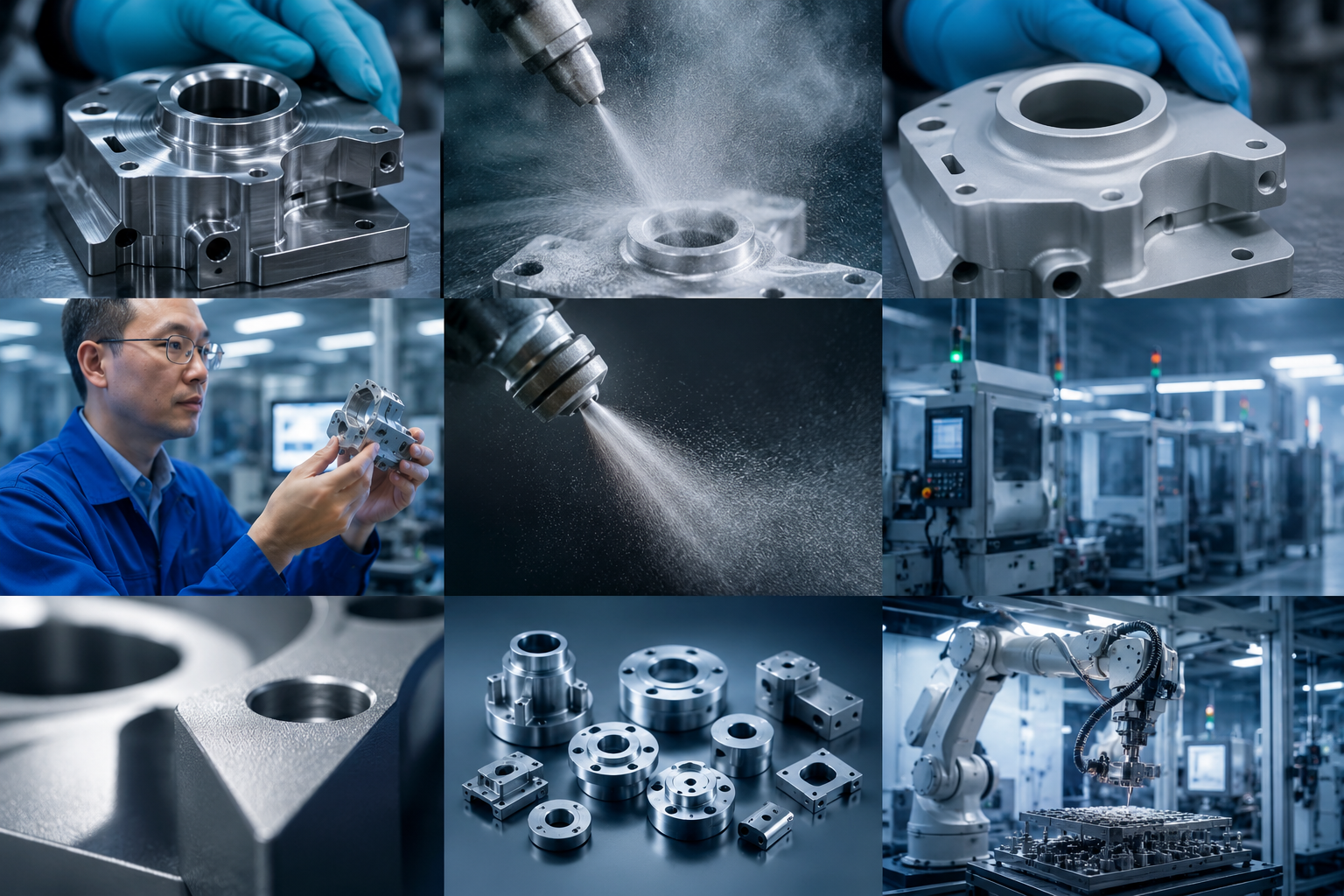
Stainless Steel Sandblasting Finish (SUS304 / SUS316) Sandblasting is a mechanical surface treatment technique that uses high-speed abrasives (usually alumina sand Al₂O₃, glass beads, or ceramic media) to uniformly impact the surface of a workpiece.
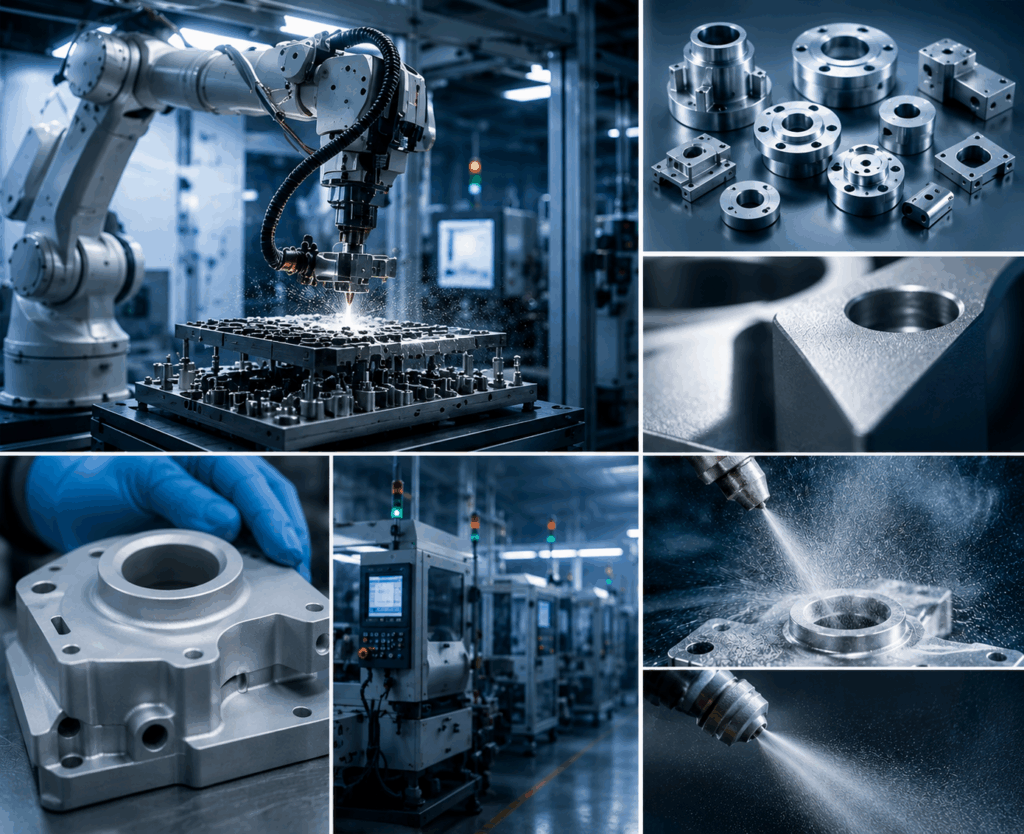
Stainless Steel Sand Blasting Finish
Precision Manufacturing & CNC Machining Process
SUS304 / SUS316 Stainless Steel Surface Finishing
Sand Blasting is a mechanical surface treatment process that utilizes high-speed abrasive media—typically Aluminum Oxide (Al₂O₃), Glass Beads, or Ceramic Beads—to uniformly impact the surface of a workpiece. It is widely applied in semiconductor equipment, automation systems, medical devices, optical components, and precision machinery industries to improve appearance, surface consistency, and remove machining marks.
1. Raw CNC Machined Components
Process Description
After CNC turning, milling, 5-axis machining, drilling, and tapping, stainless steel components usually retain:
- Tool marks
- Minor burrs
- Metallic reflections
- Machining stress traces
- Uneven surface gloss
At this stage, dimensional accuracy and machining quality are verified before surface finishing.
Common Materials
- SUS304
- SUS316
- SUS316L
- SUS303
- SUS420
Precision Inspection Equipment
- Vernier Caliper
- Micrometer
- Height Gauge
- Coordinate Measuring Machine (CMM)
Machining Equipment
- CNC Turning Center
- CNC Milling Machine
- 5-Axis Machining Center
- Automated Machining Center
Surface Condition
Surface Roughness:
Ra 0.8–3.2 μm
The surface exhibits metallic brightness with visible machining patterns.
2. Sand Blasting Process
Process Principle
Compressed air accelerates abrasive media onto the workpiece surface to achieve:
✓ Removal of machining marks
✓ Burr removal
✓ Oxide layer removal
✓ Surface contamination cleaning
✓ Elimination of minor machining traces
Resulting in a uniform matte finish.
Common Abrasive Media
① Aluminum Oxide (Al₂O₃)
Features
- Strong cutting capability
- Uniform surface texture
- Most commonly used for semiconductor equipment components
Grit Size
80#–220#
Applications
- SUS304 precision parts
- SUS316 precision parts
② Glass Beads
Features
- Fine surface texture
- Minimal dimensional change
Applications
- Medical devices
- Food processing equipment
- Optical components
③ Ceramic Beads
Features
- Long service life
- Superior surface uniformity
Applications
- High-end precision parts
- Semiconductor equipment components
Typical Process Parameters
| Item | Parameter |
|---|---|
| Air Pressure | 4–7 bar |
| Nozzle Distance | 100–250 mm |
| Spray Angle | 45°–90° |
| Abrasive Size | #80–#220 |
| Surface Roughness | Ra 0.8–2.5 μm |
Process Result
Produces a consistent and uniform matte appearance over the entire component.
3. Surface Finish Result
Uniform Matte Appearance
Reduced reflection and enhanced high-tech industrial aesthetics.
Removal of Machining Marks
Improves appearance consistency and surface uniformity.
Improved Surface Quality
Enhances adhesion for subsequent Electropolishing (EP) and PVD coating.
Reduced Fingerprint Visibility
Suitable for cleanroom and high-cleanliness equipment.
Surface Roughness Comparison
| Process | Surface Roughness |
|---|---|
| After CNC Machining | Ra 1.6–3.2 μm |
| After Sand Blasting | Ra 0.8–2.5 μm |
| After Electropolishing | Ra 0.1–0.4 μm |
4. Industrial Applications
Semiconductor Equipment
Components
- Vacuum chamber parts
- Gas distribution plates
- Brackets
- Fixtures
- Stage platforms
Requirements
✓ Low reflection
✓ High cleanliness
✓ Consistent appearance
Automation Systems
Applications
- Robot arm components
- Linear stages
- Sensor brackets
- Precision mechanical structures
Features
Enhanced durability and industrial aesthetics.
Medical Devices
Applications
- Surgical instruments
- Medical fixtures
- Inspection equipment components
Requirements
- Easy cleaning
- Low contamination
- Uniform surface quality
Optical Equipment
Applications
- Positioning fixtures
- Lens holders
- Precision structures
Requirement
Reduced reflection to avoid optical interference.
Precision Machinery Industry
Applications
- Flanges
- Brackets
- Module components
- Precision covers
Providing superior industrial appearance and quality.
5. Brand Ending
Yong Yi Technology Co., Ltd.
CNC Precision Machining & Surface Finishing
Specialized in:
Stainless Steel Precision Components
Providing:
✓ CNC Milling
✓ CNC Turning
✓ 5-Axis Machining
✓ Sand Blasting Finish
✓ Electropolishing (EP)
✓ PVD Coating
✓ Anodizing
✓ Assembly and Inspection
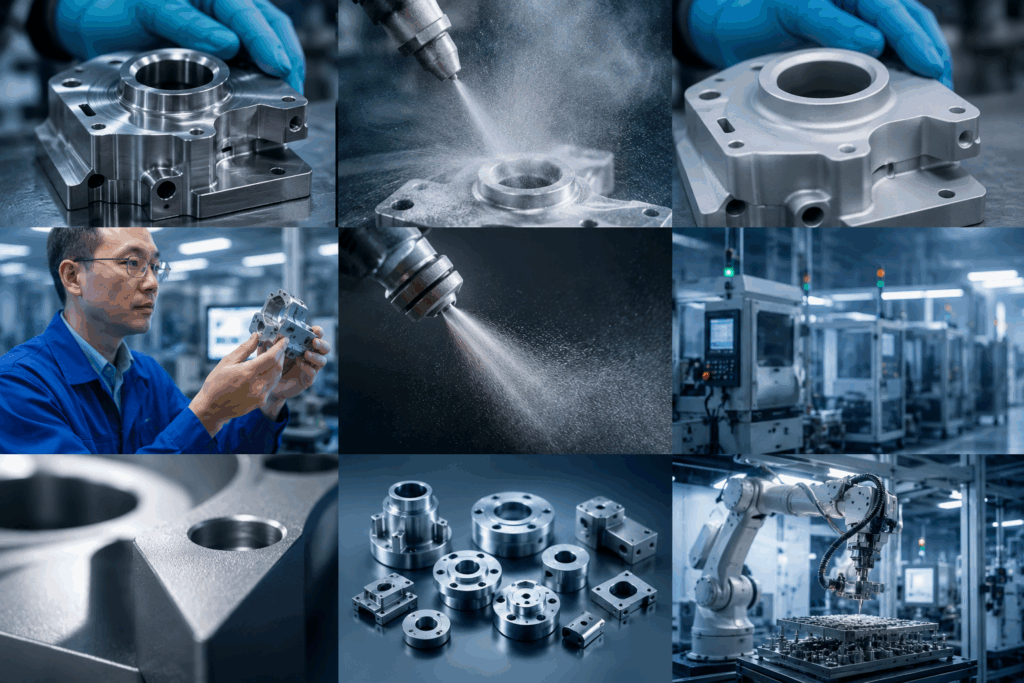
Yong Yi Technology Co., Ltd.
Location: No. 188-9, Section 1, Dafeng Road, Tanzih District, Taichung City, Taiwan 42756, China
Call: +886-4-25341382
Ring Volume: +886-4-25341847
Email: yongyi-sales@umail.hinet.net
Email: justinwu6767@gmail.com